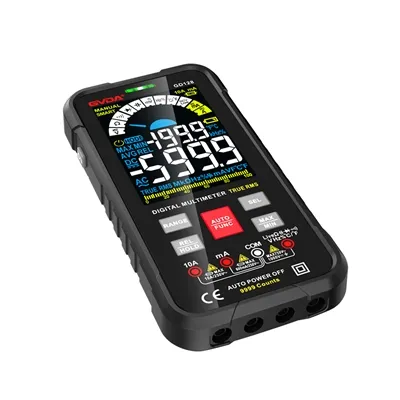
Multimeter detection filter is good or bad
What happens if the filter is broken? The multimeter detects whether the filter is good or bad
If the internal circuit of the filter is broken, the inverter will stop working, because the filter is generally connected in series with the power supply of the inverter.
If the filter fails, it may cause interference to the equipment around the inverter, which may cause the elevator to work abnormally, or the equipment around it cannot work normally, and there will be noise, abnormal movement, etc. In serious cases, can cause damage to these sensitive electromechanical devices
The difference between active filter and passive filter:
1. Active filters are electronic, and passive filters are mechanical;
2. The active filter detects a certain set harmonic order and cancels it, and the passive filter forms a certain harmonic channel through the cooperation of the reactor and the capacitor to absorb the harmonic;
3. Passive filters are used because of capacitors.
For the surface acoustic filter, its two input pins 1, 2, two output pins 3, 4, and the insulation between the input pin and the output pin, (as shown in the figure) and they are all insulated from the shielding pin 5. Therefore, when measuring the resistance between two pairs with the R×1 kΩ range of the multimeter, it should be ∞. If there is a resistance value of hundreds or thousands of ohms, it indicates that the performance of the surface acoustic filter has deteriorated, and if the resistance is small, it indicates that the surface acoustic filter has broken down.
Use a multimeter to check the light wire purpose Check whether the light wire is in good condition.
Ordinary people first put the multimeter in the voltage AC 250V range, check whether the voltage of the live wire and the neutral wire of the light wire is 220V to judge whether the live wire and the neutral wire are intact. This method works if the live or neutral wire is broken. However, if the contact is poor and intermittent, it may cause misjudgment. The reason is that when the live wire or the neutral wire is in poor contact, the current in the circuit is very small due to the large internal resistance of the voltage range of the multimeter, and this current is not enough to generate a large voltage drop at the poor contact of the live wire or the neutral wire. Therefore, the measured voltage will still be about 220V. Once the power is on and the load is applied, the voltage drop at the bad contact will increase significantly, and the power supply voltage of the lamp power supply terminal will be much lower than 220V. It will appear that the lamps do not work or work abnormally, so when using the voltage method to measure, it must be energized and tested with load.
The second method is more reliable, that is, using the resistance method, put the multimeter in the lowest ohm range, such as RX1, and zero it, then cut off the power, and disassemble the switch wire and the live wire and neutral wire on the lamp (anti- circuit), and then use a multimeter to measure the fire and neutral wires respectively. It is zero when it is intact, and there is resistance when the wire is in poor contact. The larger the resistance, the more serious the poor contact is.
Use a multimeter to detect the light line, which can be divided into two types: one is live measurement, put the meter on the AC voltage range, and put the needle on the live line and the neutral line to measure directly to see if the voltage is 220 volts. If it is close to zero volts, it means that the line There are breaking points. Test it with an electric pen. If both strands are red, it means that the neutral wire has been broken. Check the connector carefully to see if it is loose.
The second is power-off measurement. Power off the circuit switch, and use a multimeter to measure the continuity of the circuit. However, this method is not suitable because the circuit is too long and the needle cannot reach it. It is okay to measure the continuity of the bulb alone.
Based on the above, it shows that using a multimeter to measure the lamp circuit can only be judged by measuring the voltage with the voltage file, which has great limitations.
Turn the digital multimeter to the AC voltage range, wrap the black test lead wire around your finger three to five times, touch the zero line and the live wire with the red test lead respectively, and compare them. The one with the larger reading is the live wire, and the one with the smaller reading The root is the zero line.