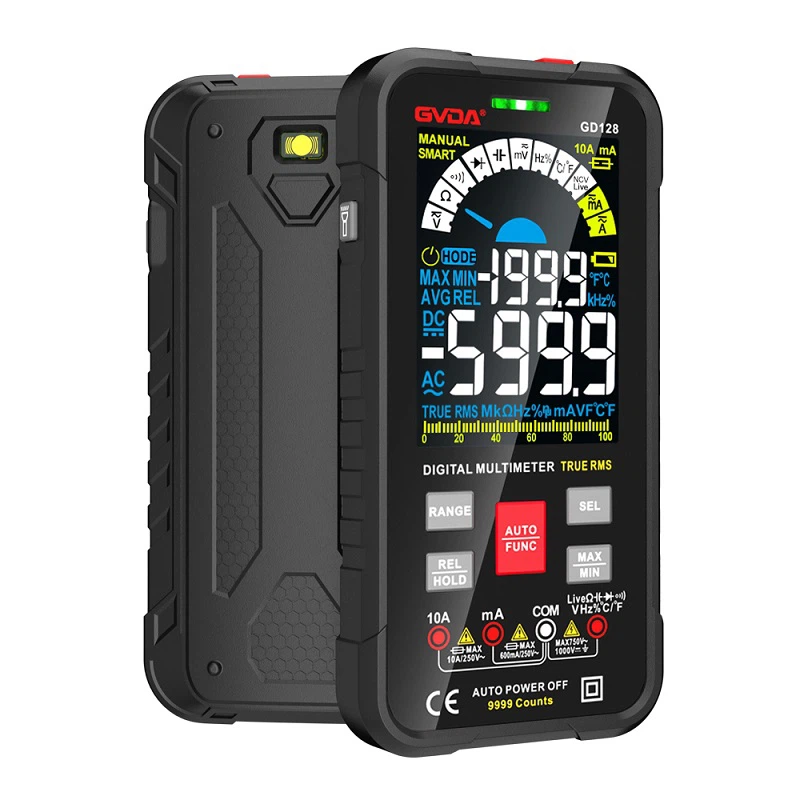
Multimeter-Measurement Tips
resistance:
1. Since the resistance value measured when the resistors are connected in parallel is wrong (this high school physics has taught, that is, how to find the resistance of a parallel circuit), so it is necessary to ensure that the resistance is not measured in parallel, so that its actual value can be measured resistance. therefore:
If the resistor is plugged into the board, it is best to unplug it or just pull out one end (to avoid connecting it to the board in parallel with other resistors).
If the resistor is not plugged into the board, make sure that one end of the resistor is only in contact with the measuring pen when measuring, so even if we touch it with our hands (the person is also conductive, and the person also has a certain resistance, the person in the video directly Measured the resistance of the hand: 8.3 megohms MΩ).
2. The range almost determines its accuracy. If you choose a too large range and then measure a small resistance, it may be displayed as 0, so you must choose an appropriate range.
Diode/on-off:
1. If it is connected, there will be a "beep", otherwise it will not work.
2. Whether it is to measure a diode, a circuit or a wire, it is to judge whether it can be turned on (it judges whether it can be turned on through a certain small current, so this gear also has a certain resistance value, otherwise the two The positive and negative poles of the two probes are shorted, and the multimeter is not burnt out).
3. Conduction does not necessarily mean that the circuit or wire has no resistance, because people with common sense know that even wires have very small resistance, so the blogger in the video said that it will be conductive if it is lower than 70Ω, so To measure a small resistance it will also conduct.
Therefore, in order to measure a certain section of the circuit in the actual circuit, we usually use the resistance of the smallest gear for measurement, so that we know the resistance value of this section, otherwise, if the on-off gear is used, even the low resistance value will drop.
The on-off file is usually used to measure whether a wire is conducting.
4. Measure the diode, that is, the diode can only conduct in one direction.
capacitance:
1. Pay attention to the positive and negative signs when plugging in the wire. It is based on the very small symbol in the middle. The result of inserting according to that symbol is the opposite of the color of the hole.
2. Capacitors have polarity, the long end is positive and connected to the red wire, but it is best to use the same as measuring resistance.
Current:
1. Pay attention to the current measurement method. If you want to measure the correct current, it is natural to connect the multimeter in series (that is, use two wires or probes to connect the multimeter to the circuit in series to become a part of the circuit, so that the current flows through the multimeter. In this way, the multimeter to measure the current.)
2. Also, note that the positive poles of A and mA should be inserted in different positions. This mistake may burn the multimeter.
3. When measuring 20A high current, you have to change two thick wires to prevent the wires from being burned.
4. The holes for the DC and AC plugs are the same, mainly because the holes for the current are different.