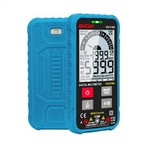
Multimeter range selection and measurement error detailed explanation
Human error in reading is one of the reasons that affect measurement accuracy. It is inevitable, but can be minimized as much as possible. Therefore, special attention should be paid to the following points during use: 1. Before measurement, the multimeter should be placed horizontally and mechanically zeroed; 2. When reading, keep your eyes perpendicular to the pointer; 3. When measuring resistance, it is necessary to zero it every time the gear is changed. If it cannot be adjusted to zero, a new battery should be replaced; 4. When measuring resistance or high voltage, do not hold the metal part of the probe with your hand to avoid human resistance shunt, increase measurement error or electric shock; 5. When measuring the resistance in an RC circuit, it is necessary to cut off the power supply in the circuit, discharge the stored electricity in the capacitor, and then proceed with the measurement. After excluding human reading errors, we conducted some analysis on other errors.
1. Selection and measurement error of voltage and current range for multimeter
The accuracy level of a multimeter is generally divided into several levels such as 0.1, 0.5, 1.5, 2.5, and 5. The calibration of accuracy (precision) levels for DC voltage, current, AC voltage, current, and other gears is expressed as the percentage of the maximum absolute allowable error △ X to the selected full-scale value of the range. Expressed in formula: A%=(△ X/full-scale value) × 100%... 1
(1) Using multimeters with different accuracies to measure the error generated by the same voltage
For example, if there is a 10V standard voltage and two multimeters with 100V gear, 0.5 level and 15V gear, and 2.5 level are used for measurement, which one has the smallest measurement error?
Solution: From equation 1: The first measurement: Maximum absolute allowable error
△ X1=± 0.5% × 100V=± 0.50V.
Second measurement: maximum absolute allowable error
△ X2=± 2.5% × l5V=± 0.375V.
Comparing △ X1 and △ X2, it can be seen that although the accuracy of the first meter is higher than that of the second meter, the error generated by measuring with the first meter is larger than that generated by measuring with the second meter. Therefore, it can be seen that when choosing a multimeter, higher accuracy is not necessarily better. With a highly accurate multimeter, it is also necessary to choose a suitable range. Only by selecting the correct range can the potential accuracy of a multimeter be fully utilized.
(2) The error caused by measuring the same voltage with different ranges of a multimeter
For example, the MF-30 multimeter has an accuracy level of 2.5. When measuring a standard voltage of 23V using 100V or 25V gears, which gear has the smallest error?
Solution: Maximum absolute allowable error for 100V gear:
X (100)=± 2.5% × 100V=± 2.5V.
The maximum absolute allowable error for 25V gear is △ X (25)=± 2.5% × 25V=± 0.625V. As can be seen from the above solution:
Measure the 23V standard voltage with 100V gear, and the reading on the multimeter is between 20.5V and 25.5V. Measure the 23V standard voltage with the 25V gear, and the reading on the multimeter is between 22.375V and 23.625V. From the above results, it can be seen that △ X (100) is greater than △ X (25), indicating that the measurement error at 100V gear is much larger than that at 25V gear. Therefore, when measuring different voltages with a multimeter, the errors generated by measuring with different ranges are not the same. When meeting the values of the measured signal, it is advisable to choose gears with smaller ranges as much as possible. This can improve the accuracy of the measurement.