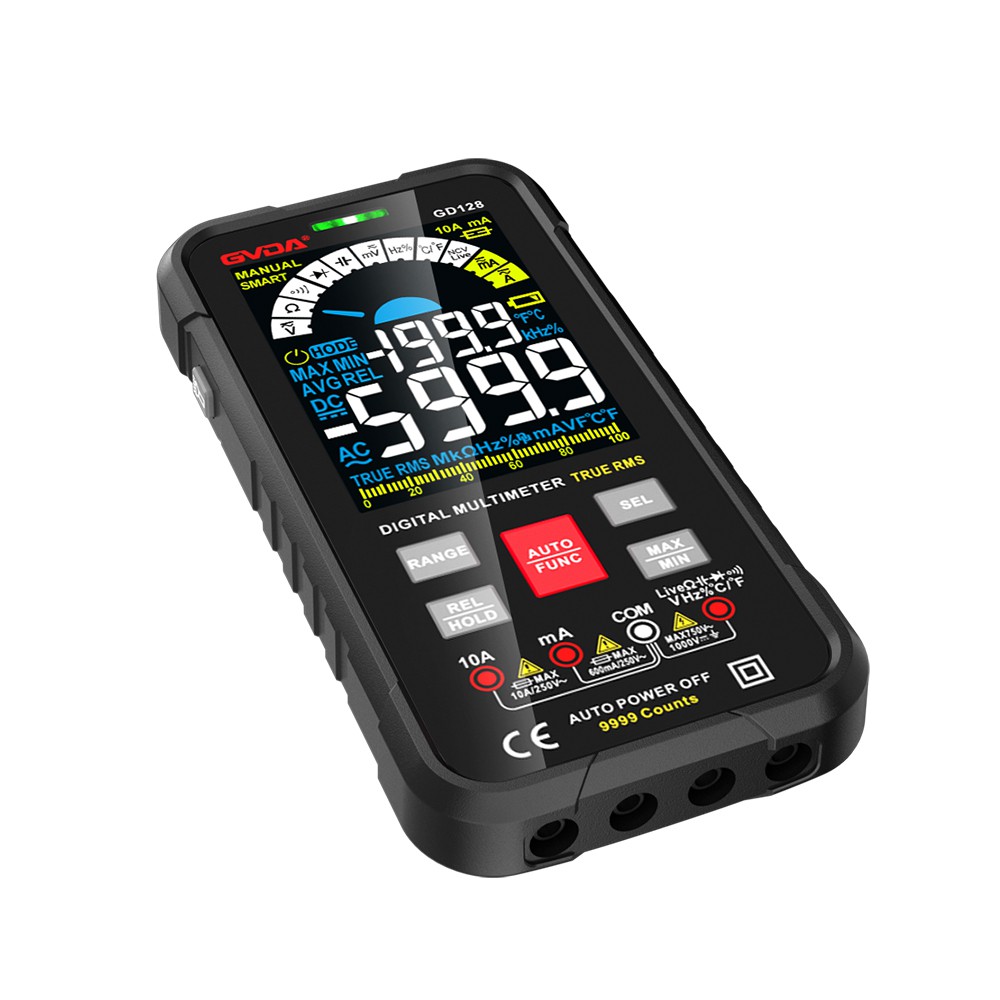
Multimeter to check circuit board short circuit fault
The multimeter can be used to detect circuit board faults in either diode or resistance mode. If using diode mode, use the probe to measure the test point separately. If the circuit board is short circuited, it will sound. If there is still an indicator light on some multimeters or if using resistance mode, it will display zero.
1. A multimeter, also known as a multimeter, multimeter, multimeter, or multimeter, is an indispensable measuring instrument in power electronics and other departments. Its main purpose is to measure voltage, current, and resistance. A multimeter is a multifunctional and multi range measuring instrument. Generally, a multimeter can measure DC current, DC voltage, AC current, AC voltage, resistance, and audio level. Some can also measure AC current, capacitance, inductance, and some parameters of semiconductors. Multimeters are divided into pointer multimeters and digital multimeters according to their display modes.
2. Measurement of DC voltage: First, insert the black probe into the "com" hole and the red probe into the "V Ω" hole. The value can be directly read from the display screen. If it shows "1.", it indicates that the range is too small, and then a large range needs to be added before measuring the industrial electrical appliances. Select the knob to a range larger than the estimated value (note: the values on the dial are all maximum ranges, "V -" represents DC voltage range, "V~" represents AC voltage range, "A" represents current range), and then connect the probe to the power supply or both ends of the power supply; Maintain stable contact. If a "-" appears on the left side of the value, it indicates that the polarity of the probe is opposite to the actual power polarity, and the red probe is connected to the negative terminal.
3. Measurement of AC voltage: The probe socket is the same as measuring DC voltage, but the knob should be turned to the required range at the "V~" position of the AC gear. There is no distinction between positive and negative AC voltage, and the measurement method is the same as before. Whether measuring AC or DC voltage, attention should be paid to personal safety and do not touch the metal part of the probe with your hands casually.
4. Resistance measurement: Set the range switch to the appropriate range of Ω, insert the red probe into the V/Ω hole, and insert the black probe into the COM hole. If the measured resistance value exceeds the maximum value of the selected range, the multimeter will display. 1. At this time, a higher range should be selected. When measuring resistance, the red probe is positive and the black probe is negative, which is exactly the opposite of a pointer multimeter. Therefore, when measuring polarized components such as transistors and electrolytic capacitors, attention must be paid to the polarity of the probes.
5. Measure current with a multimeter: First, select the range. The DC current range of the multimeter is marked with "mA" and has three ranges: 1mA, 1mA, and 100mA. The range selection should be based on the current magnitude in the circuit. Then the multimeter should be connected in series with the tested circuit. After disconnecting the corresponding part of the circuit, connect the multimeter probe to both ends of the breakpoint. Finally, the correct reading should be made. The scale line for the DC current level is still the second line. If the 100mA level is selected, the third line of numbers can be used, and the reading should be multiplied by 10.
6. Use a multimeter to measure capacitance: Some digital multimeters have the function of measuring capacitance, and the range is divided into five levels: 2000p, 20n, 200n, 2μ and 20μ. When measuring, the two pins of the discharged capacitor can be directly inserted into the Cx jack on the meter board, and the displayed data can be read after selecting the appropriate range.