Needle type multimeter and digital multimeter each have their own advantages and disadvantages
A pointer multimeter is an average type instrument that provides intuitive and visual reading indications
(Generally, reading numerical values is closely related to the angle of pointer swing, so it is very intuitive)
A digital multimeter is an instantaneous sampling instrument that uses a sample taken every 0.3 seconds to display measurement results. Sometimes, each sampling result is only very similar and not exactly the same. This is not as convenient for reading results as a pointer type
A pointer type multimeter generally does not have an amplifier inside, so its internal resistance is small. For example, the MF-10 model has a DC voltage sensitivity of 100 kiloohms/volt. This is considered excellent The DC voltage sensitivity of the MF-500 model is 20 kiloohms/volt
The digital multimeter uses an operational amplifier circuit internally, and the internal resistance can be very high, often around 1M ohms or higher (i.e. higher sensitivity can be achieved). This allows for less impact on the measured circuit and higher measurement accuracy
Due to its small internal resistance and the use of discrete components to form a shunt voltage divider circuit, the frequency characteristics of a pointer type multimeter are uneven (compared to digital ones). On the other hand, the frequency characteristics of a pointer type multimeter are relatively better
The internal structure of the pointer type multimeter is simple, so the cost is low. It has fewer functions, simple maintenance, and strong overcurrent and overvoltage capabilities
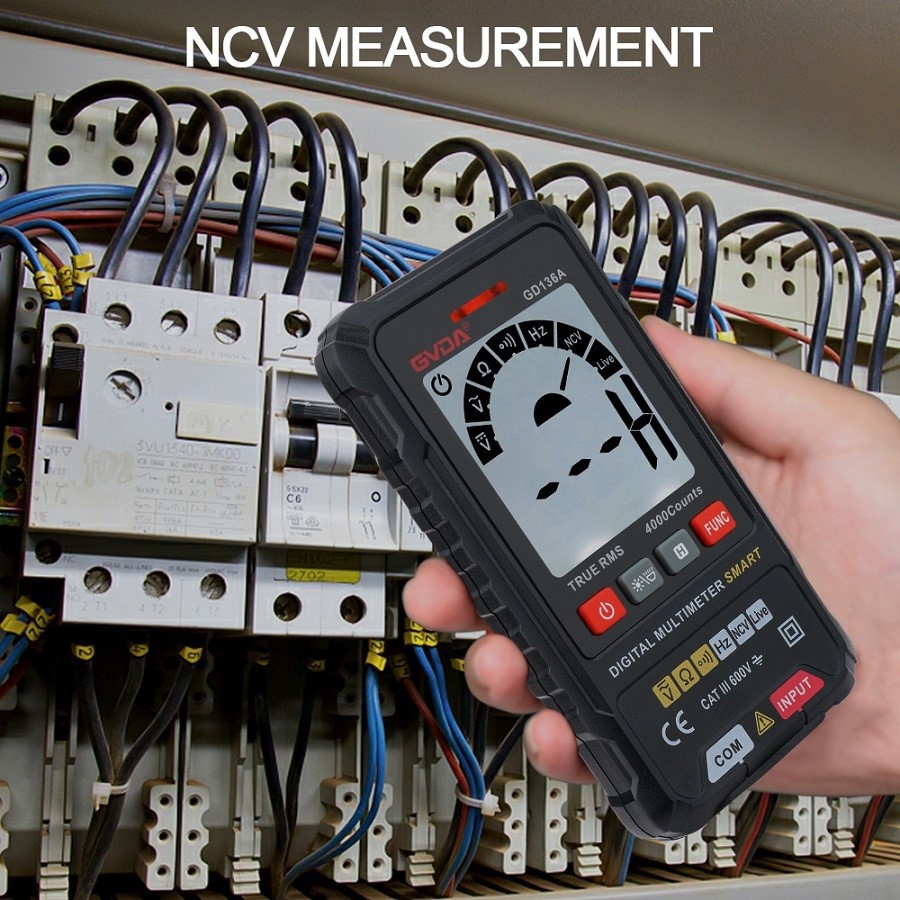
The digital multimeter uses various oscillation, amplification, frequency division, protection and other circuits internally, so it has many functions, such as measuring temperature, frequency (in a lower range), capacitance, inductance, or serving as a signal generator, etc
Due to the use of integrated circuits in the internal structure, the overload capacity is poor (However, some of them are now capable of automatic shifting, automatic protection, etc., but they are more complex to use.) After damage, it is generally not easy to repair
The output voltage of a digital multimeter is relatively low (usually not exceeding 1 volt). It is inconvenient to test some components with special voltage characteristics (such as thyristors, light-emitting diodes, etc.)
The output voltage of the pointer type multimeter is relatively high, such as 10.5 volts, 12 volts, etc
The current is also large (such as MF-500 * 1 ohm * about 100 milliamperes), making it convenient to test thyristors, light-emitting diodes, and so on
For beginners, a pointer type multimeter should be used