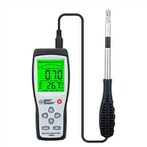
Noise Meter - Environmental Detection
Noise meter, also known as (noise meter, sound level meter) is the most basic instrument in noise measurement. A sound level meter is generally composed of a condenser microphone, a preamplifier, an attenuator, an amplifier, a frequency meter network, and an effective value indicating meter. The working principle of the sound level meter is: the microphone converts the sound into an electrical signal, and then the preamplifier transforms the impedance to match the microphone with the attenuator. The amplifier adds the output signal to the network, performs frequency weighting on the signal (or an external filter), and then amplifies the signal to a certain amplitude through the attenuator and the amplifier, and sends it to the RMS detector.
Noise meter principle
The frequency weighting network in the noise meter has three standard weighting networks: A, B, and C. The A network is to simulate the human ear's response to the 40-square pure tone in the equal-loudness curve. Its noise meter curve shape is opposite to the 340-square equal-loudness curve, so that the middle and low frequency bands of the electrical signal are greatly attenuated. The B network simulates the human ear's response to the 70-square pure tone, and it attenuates the low-frequency band of the electrical signal to a certain extent. The C network simulates the response of the human ear to a 100-square pure tone, and has a nearly flat response throughout the entire audio frequency range. The sound pressure level measured by the sound level meter through the frequency weighting network is called the sound level. According to the weighting network used, it is called A sound level, B sound level and C sound level, and the unit is recorded as dB(A) , dB(B) and dB(C). At present, the sound level meter used to measure noise can be divided into four types according to the sensitivity of the meter head response:
1. "Slow". The time constant of the meter head is 1000ms, which is generally used to measure steady-state noise, and the measured value is an effective value.
2. "Quick". The time constant of the meter head is 125ms, which is generally used to measure unstable noise and traffic noise with large fluctuations. The fast gear is close to the human ear's response to sound.
3. "Pulse or pulse hold". The rising time of the needle is 35ms, which is used to measure the pulse noise with a long duration, such as punch press, hammer, etc. The measured value is the maximum effective value.
4. "Peak hold". The rise time of the hands is less than 20ms. It is used to measure short-duration impulsive sounds, such as guns, cannons and explosions, and the measured value is the peak value. That is the maximum value.
The sound level meter can be connected with an external filter and recorder to perform spectrum analysis on the noise. The domestic ND2 precision sound level meter is equipped with an octave page filter, which is easy to carry to the scene and do spectrum analysis. Sound level meters can be divided into precision sound level meters and ordinary sound level meters according to their accuracy. The measurement error of a precision sound level meter is about ±1dB, and that of an ordinary sound level meter is about ±3dB. Sound level meters can be divided into two categories according to their uses: one is used to measure steady-state noise, and the other is used to measure unsteady-state noise and impulse noise. Integrating sound level meters are used to measure the equivalent sound level of unsteady noise over a period of time. Noise dosimeter is also an integrating sound level meter, mainly used to measure noise exposure. Impulse sound level meter is used to measure impulse noise. This sound level meter conforms to the human ear's response to impulse sound and the average time of human ear's response to impulse sound.
Noise meter - standard regulations
In order to make the measurement results of sound level meters produced in various countries in the world comparable with each other, the International Electrotechnical Commission (IEC) formulated relevant standards for sound level meters and recommended them to be adopted by all countries. In May 1979, IEC651 "Sound Level Meter" was passed in Stockholm. Standards, China's national standard for sound level meters is GB3785-83 "Sound Level Meter Electricity, Sound Performance and Test Methods". In 1984, IEC passed the international standard of IEC804 "Integral Average Sound Level Meter", and in 1997, China promulgated GB/T17181-1997 "Integral Average Sound Level Meter". They are mainly consistent with the IEC standard. In 2002, the International Electrotechnical Commission (IEC) released the new international standard IEC61672-2002 "Sound Level Meter". This standard replaces the original IEC651-1979 "Sound Level Meter" and IEC804-1983 "Integral Average Sound Level Meter". According to this standard, China has formulated JJG188-2002 "Sound Level Meter" verification regulations. According to the new standard, the sound level meter can be divided into general sound level meter, integral sound level meter, spectrum sound level meter, etc. according to the purpose, and can be divided into level 1 and level 2 according to the accuracy. The performance indicators have the same central value, only the allowable error is different, and as the number of levels increases, the allowable error is relaxed. According to volume, it can also be divided into desktop, portable, and pocket sound level meters. According to its indication method, it can be divided into analog indication and digital indication sound level meter.