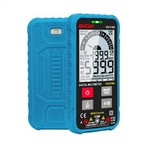
How to use the noise meter
Whether the noise meter is used correctly or not directly affects the accuracy of the measurement results. When measuring, the instrument should choose the correct gear according to the situation, and hold the noise with both hands.
The noise meter for measuring noise, the response of the meter head can be divided into four types according to the sensitivity:
1. "Slow". The time constant of the meter head is 1000ms, which is generally used to measure steady-state noise, and the measured value is the effective value.
2, "fast". The time constant of the meter head is 125ms, which is generally used to measure unstable noise and traffic noise with large fluctuations. Fast gear is close to the human ear's response to sound.
3. "Pulse or pulse hold". The rise time of the needle is 35ms, which is used to measure pulse noise with a long duration, such as punches, hammers, etc. The measured value is the maximum effective value.
4. "Peak Hold". The rising time of the needle is less than 20ms. Used to measure short-duration impulse sounds, such as guns, cannons and explosions, the measured value is the peak value. That is, the maximum value. Distance meter, altimeter, laser line cast meter, flow meter, GPS thickness gauge, level meter, flat meter, waveform recorder, test fixture, voltage and current recorder, data set recorder, graphic recorder, flow totalizer.
Precautions for the use of noise meters
1. Read the manual before use to understand the usage and precautions of the instrument.
2. Pay attention to the polarity when installing the battery or external power supply, and do not reverse the connection. The battery should be removed if it is not used for a long time, so as not to damage the instrument due to leakage.
3. Do not disassemble the microphone to prevent throwing, and place it properly when not in use.
4. The instrument should not be placed in places with high temperature, humidity, sewage, dust, air or chemical gas with high hydrochloric acid and alkali components.
5. Do not disassemble the instrument without authorization. If the instrument is not normal, it can be sent to the repair unit or the factory for overhaul.
6. Note that the noise meter is waterproof to prevent falling from high altitudes.
Factors Affecting Noise Meter Measurements
The noise meter is mainly used to measure noise, and the classification of noise measurement mainly includes the following:
1. From the measurement object, it can be divided into the characteristic measurement of environmental noise (sound field) and the measurement of sound source characteristics.
2. According to the time characteristics of the sound source or sound field, it can be divided into steady-state noise measurement and non-steady-state noise measurement. Unsteady noise can be divided into periodic variation noise, irregular variation noise and impulse sound.
3. According to the frequency characteristics of the sound source or sound field, it can be divided into broadband noise, narrowband noise and noise containing prominent pure tone components.
4. According to the accuracy of measurement requirements, it can be divided into precision measurement, engineering measurement and noise census.
Noise Meter - Analysis and Repair of Common Faults
1. No display on the display
(1) The internal battery connection is disconnected or the battery contact is not good: Solder the connection and replace the battery contact piece.
(2) Damaged battery: replace the battery.
2. The measurement reading is obviously low or the calibration is less than 94.0dB.
(1) The microphone sensitivity is too low or damaged: replace the microphone and recalibrate.
(2) The contacts of the preamplifier are not in good contact with the microphone: clean the contacts.
(3) The plug of the preamplifier is not in good contact with the socket of the host: replace the plug and socket.
3. The reading is too high during low sound level measurement, and the ground wire of the preamplifier is in poor contact: tighten the outer sleeve.