Optical properties of biological microscopes
The optical performance of the microscope is determined by the following eight basic optical parameters (or parameters):
(1) Numerical aperture
Numerical aperture is also called mirror ratio. It refers to the product of the refractive index n of the medium between the observed object and the lens and the sine value of half of the objective lens angle α. Use N.A or A. to represent. N.A.=nsin(α/2)
The so-called mirror mouth angle refers to the angle between the marginal rays of the observed point entering the front lens of the objective lens.
The numerical aperture is an important parameter of the objective lens and the condenser lens, and is closely related to other optical parameters of the microscope. It is generally hoped that the bigger the better. It can be seen from the formula that there are two ways to increase the numerical aperture, one is to increase the mirror mouth angle, and the other is to increase the refractive index between the objective lens and the specimen.
When the former method is adopted, the specimen and the object can be kept as close as possible. But no matter how close, α is always less than 180°. Thus, sin(α/2) is also smaller than 1. The refractive index of air is n=1. Therefore, the numerical aperture nsin(α/2) of the dry objective lens is always less than 1, generally between 0.04 and 0.95.
When the latter method is adopted, a medium with a higher refractive index can be added between the objective lens and the specimen. For example, the refractive index of cedar oil is n=1.515. When cedar oil is used as the medium, the numerical aperture can reach more than 1.2. That's why in some cases oil spectacles are used. At present, the maximum numerical aperture that the oil lens can achieve is 1.4.
(2) Resolution
Resolution is also called discrimination rate or resolving power. The so-called resolution refers to the ability of the microscope to distinguish the fine structure of the object under inspection. It is inversely proportional to the resolution distance. The resolution distance refers to the minimum distance between two object points that can be distinguished. The smaller the resolving distance, the higher the resolution of the microscope. If the distance between two object points is smaller than the resolution distance, the two points will be mistaken for one point, and its structure cannot be seen clearly. The resolution of the microscope is determined by the objective lens. Eyepieces only magnify and do not increase the resolution of the microscope.
In the case of normal central illumination, the resolving distance d of the objective lens is determined by the following formula.
d=(λ/2)N.A.
In the formula: d represents the resolution distance, the unit is micron, λ represents the wavelength of the illumination light, the unit is also micron.
In visible light, the wavelength with the greatest brightness and the most sensitivity to human eyes is 0.55 μm, and the maximum N.A. of the objective lens is 1.4. Substituting into the above formula, d is approximately 0.2 μm. That is, with an ordinary optical microscope, the limit of the resolution distance is 0.2 μm in the case of central illumination. That is to say, ordinary optical microscopes cannot distinguish between two objects smaller than 0.2 μm.
Using ultraviolet light, the wavelength of the illumination light can be reduced, enabling the resolution distance to reach 0.1 μm. But ultraviolet rays cannot be seen by the human eye. It can only be observed after taking a picture.
The wavelength of electron flow is only 0.00387nm. Using "electron lens" or magnetic lens to control the flow of electrons, the resolution distance of the electron microscope is up to a few tenths of a nanometer. It can be used to observe the structure of atoms.
(3) Magnification
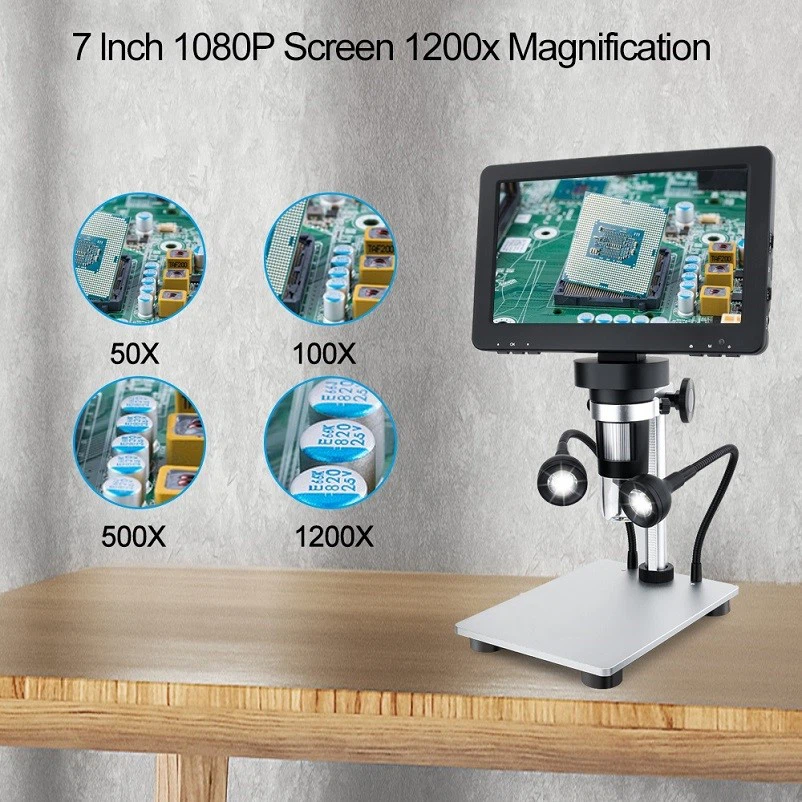
The magnification of the microscope is equal to the product of the magnification of the objective lens and the magnification of the eyepiece. In principle, the magnification can be made very large. However, if the details of the specimen cannot be resolved by the objective lens, no matter how large the magnification is, it is meaningless. Theoretically, it can be deduced that the most suitable magnification of the microscope (called the effective magnification, represented by M effectively) is between 500 and 1000 times the numerical aperture of the objective lens. That is, 500N.A.≤M effective≤1000N.A.
Within the effective magnification range, the eyes can observe for a long time without fatigue. If the magnification is lower than 500 N.A., it will be difficult to observe. If it is higher than 1000N.A., it will deteriorate the image quality and even cause an unreal image. Therefore, the magnification over 1000N.A. is called invalid magnification.
(4) Working distance
The working distance refers to the distance between the lower surface of the objective lens and the upper surface of the cover glass after the microscope is focused, using a standard cover glass and a standard mechanical tube length. The higher the magnification of the objective lens, the shorter the working distance. Generally, the working distance of the low-power objective lens below 10 times is 5-7mm, while the working distance of the 100 times oil lens is only about 0.19mm.
(5) Depth of focus
When the microscope is focused on a certain plane in the specimen, not only the object plane can be seen clearly, but also the upper and lower object planes connected to it can be seen clearly at the same time. The distance between the upper and lower object planes is called the depth of focus, or depth of focus for short.
The depth of focus of the microscope is very small, and the larger the numerical aperture, the greater the total magnification, and the smaller the depth of focus. For example, when using an oil lens with an N.A. of 1.25/100 times and a 12.5 times eyepiece to observe, the depth of focus is only 0.27 μm. That is to say, after focusing, only a thin layer of 0.27 μm thick can be seen clearly at a time. Ordinary specimens are generally several microns thick. To see the entire specimen, it is necessary to use the fine-tuning mechanism of the microscope to observe in layers from top to bottom.
(6) field of view
The field of view is also called the field of view. Refers to the scope of the object under inspection that the microscope can see at one time. Usually we want the field of view to be as large as possible. The field of view of the microscope is determined by the field of view of the objective lens and the field of view of the eyepiece. The field of view of ordinary objective lens is less than 20mm, and the large one can reach more than 40mm. The field of view of ordinary 10x eyepieces is 14mm, and the large ones can reach more than 24mm. Once the objective and eyepiece are designed, their field of view is fixed. Because the field of view of a general microscope is small, it is impossible to see the entire specimen in one field of view, only a very small circle on the specimen can be seen. Moreover, the size of the field of view is inversely proportional to the total magnification of the microscope. The greater the total magnification, the smaller the field of view. The solution is to use the mover to make each part of the specimen enter the field of view in turn and observe in turn.
(7) Mirror brightness
Mirror brightness refers to the lightness and darkness of the object image seen in the microscope. In order to facilitate observation, we hope that the resulting image is brighter. In the case of constant external light, the mirror brightness is proportional to the square of the numerical aperture and inversely proportional to the square of the total magnification. To make the image brighter, an objective lens with a large numerical aperture should be used with a low magnification eyepiece. For example, in the case of the same objective lens, using a 5X eyepiece will produce a mirror image that is 4 times brighter than using a 10X eyepiece.
For microscopes using electric light sources, the brightness of the mirror image can be controlled by adjusting the brightness of the illuminator.
(8) Clarity
The clarity of microscope imaging depends on its optical system, especially the optical performance of the objective lens. It is related to the design, manufacture, use and storage of microscopes. It is an important and complex issue. From the perspective of use and storage, the main reasons that affect the clarity are: the thickness of the cover glass used is unqualified, the focus is not adjusted to the ideal position, the total magnification is too large, and the lens of the oil lens is not wiped. Clean, lens mildew, etc.