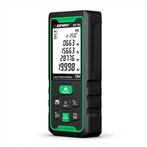
Precautions for Coating Thickness Gauge (1)
The coating thickness gauge mainly uses the change of the magnetic field strength of the electromagnetic field on the medium of different thickness to calculate the thickness value. Therefore, any influence on the strength of the magnetic field will directly lead to measurement errors in the following cases:
1. The tested material itself contains magnetism
Some materials have residual magnetic fields in the measured materials during the processing or certain technological requirements. Due to its uneven distribution, the resulting measurement errors are also inconsistent, and the measurement values of certain parts on the same workpiece will suddenly become larger or smaller.
2. The structure of the tested material is different and the shape is different
On workpieces with different structures, the magnetic field distribution will vary with different structures and shapes, resulting in measurement errors.
3. Different parts of the same material may also produce changes in the magnetic field. For example, the edge and the middle area of the material have different magnetic field distributions, which will cause measurement errors.
4. The properties of the tested material are different, and the magnetic flux will be different, which is also one of the reasons for the error.
Matters needing attention in the use of coating thickness gauge (2)
Because the electromagnetic field has different distribution forms on different surface structures, it leads to measurement errors. In order to avoid errors caused by operation, please follow the following principles when using:
1. When repeating the measurement at the same point, the probe should be separated by more than 10cm each time, and the measurement should be repeated after a few seconds, so as to avoid the magnetization of the probe, which will affect the next measurement result;
2. When using, the plane is adjusted to zero to measure the plane, the convex surface is adjusted to zero to measure the convex surface, and the concave surface is adjusted to zero to measure the concave surface, so as to avoid measurement errors due to different structures;
3. Try to use the material to be measured as the zero-adjusting matrix to avoid measurement errors due to different magnetic permeability of different materials;
4. Try to zero-adjust the same part of the material to be tested, and then measure the same part again. For example, zero adjustment should be made at the edge and the middle of the workpiece;
5. The surface used for zero adjustment should be as smooth as possible; the roughness of the surface of the tested material has a great influence on the measured value, if the surface is not smooth, the average value should be taken according to the situation;
6. When measuring, the probe should be kept perpendicular to the surface of the material to be measured, otherwise a large error will occur..
1. Magnetic attraction measurement principle and thickness gauge
The suction force between the magnet (probe) and the magnetically conductive steel is proportional to the distance between the two, which is the thickness of the coating. Using this principle to make a thickness gauge, as long as the difference between the magnetic permeability of the coating and the substrate is large enough, it can be measured. In view of the fact that most industrial products are stamped and formed by structural steel and hot-rolled and cold-rolled steel plates, magnetic thickness gauges are the most widely used. The basic structure of the thickness gauge is composed of magnetic steel, relay spring, scale and self-stop mechanism. After the magnet and the object to be measured are attracted, the measuring spring is gradually elongated, and the pulling force is gradually increased. When the pulling force is just greater than the suction force, the thickness of the coating can be obtained by recording the pulling force at the moment when the magnetic steel is detached. Newer products automate this recording process. Different models have different ranges and applicable occasions. The characteristics of this instrument are easy to operate, sturdy and durable, no power supply, no calibration before measurement, and low price, which is very suitable for on-site quality control in workshops.
2. Principle of eddy current measurement
The high-frequency AC signal generates an electromagnetic field in the probe coil, and when the probe is close to the conductor, eddy currents are formed in it. The closer the probe is to the conductive substrate, the greater the eddy current and the greater the reflection impedance. This feedback action characterizes the distance between the probe and the conductive substrate, that is, the thickness of the non-conductive coating on the conductive substrate. Because these probes are designed to measure the thickness of coatings on non-ferromagnetic metal substrates, they are often referred to as non-magnetic probes. Non-magnetic probes use high-frequency materials as coil cores, such as platinum-nickel alloys or other new materials. Compared with the principle of magnetic induction, the main difference is that the probe is different, the frequency of the signal is different, and the size and scale relationship of the signal are different. Like the magnetic induction thickness gauge, the eddy current thickness gauge also achieves a high resolution of 0.1um, an allowable error of 1%, and a range of 10mm. The thickness gauge using the eddy current principle can measure non-conductor coatings on all conductors in principle, such as paint on the surface of aerospace aircraft, vehicles, household appliances, aluminum alloy doors and windows and other aluminum products, plastic coatings and Anodized film. The cladding material has a certain conductivity, which can also be measured by calibration, but the ratio of the conductivity of the two is required to be at least 3-5 times different (such as chrome plating on copper). Although the steel matrix is also an electrical conductor, it is more suitable to use the magnetic principle for such tasks.
3. The principle of magnetic induction measurement
When using the principle of magnetic induction, the thickness of the coating is measured by the size of the magnetic flux flowing into the ferromagnetic matrix from the probe through the non-ferromagnetic coating. The size of the corresponding magnetoresistance can also be measured to express the thickness of the coating. The thicker the coating, the greater the magnetoresistance and the smaller the magnetic flux. The thickness gauge using the principle of magnetic induction can in principle have the thickness of the non-magnetic conductive coating on the magnetic conductive substrate. Generally, the magnetic permeability of the substrate is required to be above 500. If the cladding material is also magnetic, the difference in permeability from the base material is required to be large enough (eg, nickel plating on steel). When the probe with the coil on the soft core is placed on the sample to be tested, the instrument automatically outputs the test current or test signal. Early products used a pointer-type meter to measure the magnitude of the induced electromotive force, and the instrument amplifies the signal and then indicates the thickness of the coating. In recent years, the circuit design has introduced new technologies such as frequency stabilization, phase locking, temperature compensation, etc., and uses magnetoresistance to modulate the measurement signal. The designed integrated circuit is also used, and the microcomputer is introduced, so that the measurement accuracy and reproducibility have been greatly improved (almost an order of magnitude). The modern magnetic induction thickness gauge has a resolution of 0.1um, an allowable error of 1%, and a range of 10mm. The magnetic principle thickness gauge can be used to measure the paint layer on the steel surface, the protective layer of porcelain and enamel, the coating of plastic and rubber, the electroplating layer of various non-ferrous metals including nickel-chromium, and the various anti-corrosion coatings of chemical and petroleum industries.