Principle of using laser rangefinder to control industrial automation
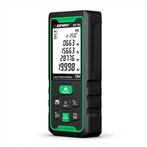
The industrial IMPULSE prismless laser rangefinder produced by American Laser Technology Company and Hong Kong Diocesan Engineering Co., Ltd. is the domestic general agent. It has a standard RS232 serial port output function and can continuously collect data every 0.7 seconds. data. The instrument transmits the measured slant distance, vertical distance, horizontal distance, tilt angle and other parameters to the computer through the RS232 data port. The computer determines the position of the target based on the obtained data, thereby controlling the mechanical components to change the position of the target, achieving highly automatic control. Purpose.
The structural features of IMPULSE allow you to simply use the red dot in the aiming eyepiece installed on IMPULSE, aim, press the launch button, and obtain distance, altitude and other data within 1 second. No prism required for reflective target. The measurement feature of IMPULSE is that it can measure data such as horizontal distance, inclination and height by using multi-function menu operation and built-in inclination sensor (type 200 and 200LR). In terms of use, IMPULSE is even more considerate of customer needs and provides functions such as left- and right-hand operation, data downloading, and optional remote control triggering.
In addition, the IMPULSE used in combination with options such as MapStar is even more powerful. It can immediately become the most portable X, Y, Z three-dimensional measurement system, and can be used through the data output port and Collector, software and other options to meet customers' wider measurement needs.
Structural features: Aiming eyepiece - There is a red aiming point inside the aiming eyepiece to help you accurately aim at the target. The intensity of the red dot is adjustable to adapt to different light environments. Emitter Mirror--IMPULSE emits infrared laser signals through the emitter mirror. Receiver mirror----The receiver mirror receives the reflected infrared ray and transmits the signal to the internal circuit of the instrument for calculation. Operation buttons------The three operation buttons can perform dozens of operations through different combinations to meet different work needs. The speaker----reports the working status of the instrument to you through different sounds. LCD screen------The sophisticated backlit LCD screen can meet your day and night operation needs and display the data you want anytime and anywhere. Data output port----IMPULSE provides the function of data download. You only need to use the data output port to download the data for more detailed processing.
Internal structure: IMPULSE is mainly composed of a large-range laser sensor, a fluid tilt sensor, a sighting eyepiece and a data output port. IMPULSE combines the sensor with software, operates it through the three buttons on the panels on both sides of the instrument, and obtains data on the LCD display on the rear panel.
Working principle: IMPULSE provides instant distance and angle values through laser sensors and tilt sensors. When performing measurement work, IMPULSE emits a beam of infrared rays from the transmitting mirror. The infrared rays hit the target and are reflected back to the receiving mirror. The laser sensor of IMPULSE calculates the elapsed time of the short infrared pulse. To determine the distance value, the tilt sensor is responsible for measuring the vertical angle, calculating and determining data such as height, elevation angle, slope, horizontal distance, etc.
IMPULSE has great spectral sensitivity and can measure reflective and non-reflective targets. The maximum distance can be 600 meters (2000 feet), but the actual maximum distance is affected by the specific target and surrounding environmental conditions, and is determined by the surrounding environmental conditions. The tilt sensor is capable of 360-degree measurements. The instrument is displayed as ±180 degrees by the tilt sensor. The instrument remains horizontal at 0 degrees, rotating upward is a + value, and rotating downward is a - value.