Principles of Reading Microscopes
First perform zero adjustment, and adjust the rotating nut so that the marking line is aligned with the full scale line of the X-axis. The rotating nut is divided into 50 grids, each grid is 0.01mm. The marking line is on glass sheet A, and the X axis is on glass sheet B. After the zero adjustment, use the hardness tester to indent the workpiece, the force F applied by the hardness tester and the diameter D of the steel ball. Adjust the rotating nut so that the contact connected to the nut pushes the glass sheet A to move in the X-axis direction, and is tangent to the indentation twice respectively. There is a spring connection between the glass sheet A and the contact, which can be freely expanded and contracted. The distance traveled by the marking line can be read through a microscope, which is the diameter of the indentation. However, since the indentation is usually irregular in shape, the workpiece should be rotated 90° and measured again to obtain the average value.
How to use a reading microscope
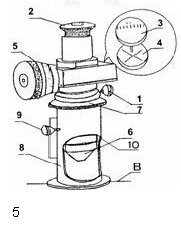
Put the micrometer microscope on the surface of the object to be measured, with the notch of the mirror base facing the direction of the light, press and hold the mirror base (8) to adjust the eyepiece (2) so that the reticle in the visual field can be adjusted clearly, and turn the mirror base to adjust the focus Ring (7) to make the object under test magnified by the objective lens clearly on the eyepiece reticle (3), loosen and lock the lens holder (1), then lock the object under test, and turn the micrometer drum (5) Make the reticle with a cross and double engraved lines aim at the image of the object to be measured. The boundary of the area needs to be measured. Read the integer value on the fixed ruler plus the mantissa value on the micrometer drum, which is the measured value. Read the starting point of the object image boundary (a), and then turn the micrometer drum to make the reticle with crosses and double-lined lines aim at the other end boundary of the area to be measured, and read the integer value on the fixed scale plus The mantissa value on the micrometer drum is the end reading (b) of the measured object image boundary, the difference between the two reading values (a-b) divided by the magnification of the objective lens (X), (a-b)÷x=Y The measured value of the actual measured object.