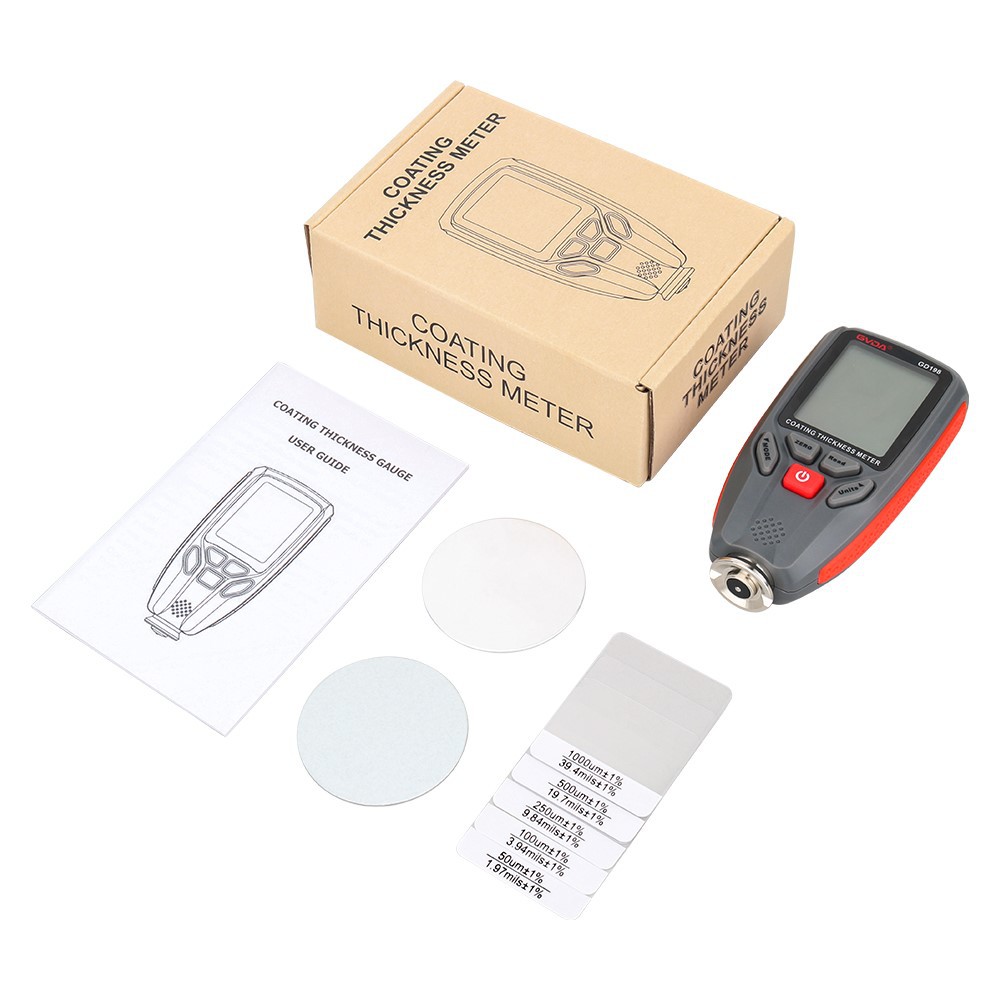
Principles of Ultrasonic Thickness Gauge and Coating Thickness Gauge
Ultrasonic thickness gauges can be divided into several types based on their working principles, including resonance method, interference method, and pulse reflection method. Since pulse reflection method does not involve resonance mechanism and is not closely related to the surface smoothness of the measured object, ultrasonic pulse method thickness gauge is a popular instrument among users.
1 Working principle
The ultrasonic thickness gauge mainly consists of two parts: the main unit and the probe. The host circuit includes three parts: the transmission circuit, the reception circuit, and the counting display circuit. The high-voltage shock wave generated by the transmission circuit excites the probe, generating ultrasonic transmission pulse waves. The pulse waves are reflected at the interface of the medium and received by the reception circuit. After counting and processing by the microcontroller, the thickness value is displayed on the liquid crystal display. It mainly obtains the thickness of the sample by multiplying the propagation speed of the sound wave in the sample by half of the time it passes through the sample.
2 Application areas of thickness gauge
Due to the convenience and good directionality of ultrasonic processing, ultrasonic technology can measure the thickness of metal and non-metal materials quickly, accurately, and pollution-free. Especially in situations where only one side is allowed to be touched, its superiority can be demonstrated. It is widely used in various sheet metal, pipe wall thicknesses, boiler vessel wall thicknesses, and local corrosion and rusting situations. Therefore, it is suitable for product inspection in various industrial sectors such as metallurgy, shipbuilding, machinery, chemical industry, power, and atomic energy,
It plays a major role in equipment operation and modern management.
Ultrasonic cleaning and ultrasonic thickness gauge are only a part of the application of ultrasonic technology, and there are many other fields that can be applied to ultrasonic technology. For example, ultrasonic atomization, ultrasonic welding, ultrasonic drilling, ultrasonic grinding, ultrasonic level gauge, ultrasonic level gauge, ultrasonic polishing, ultrasonic cleaning machine, ultrasonic motor, and so on. Ultrasonic technology will be increasingly widely used in various industries.