Probe selection
Thermal probe of anemometer
The working principle of the thermal probe of the anemometer anemometer is based on the cold impact airflow to take away the heat on the thermal element, and with the help of an adjustment switch to keep the temperature constant, the adjustment current is proportional to the flow rate. When using thermal probes in turbulent flow, airflow from all directions hits the thermal element simultaneously, affecting the accuracy of the measurement results. When measuring in turbulent flow, thermal anemometer flow sensors tend to have higher indications than rotor probes. The above phenomena can be observed during pipeline measurement. Depending on the design that manages the turbulence in the pipe, it can occur even at low speeds. Therefore, the anemometer measurement process should be carried out on the straight section of the pipeline. The starting point of the straight line should be at least 10×D before the measurement point (D=pipe diameter, in CM); the end point should be at least 4×D behind the measurement point. The fluid cross section must not be obstructed in any way. (angular, resuspension, object, etc.)
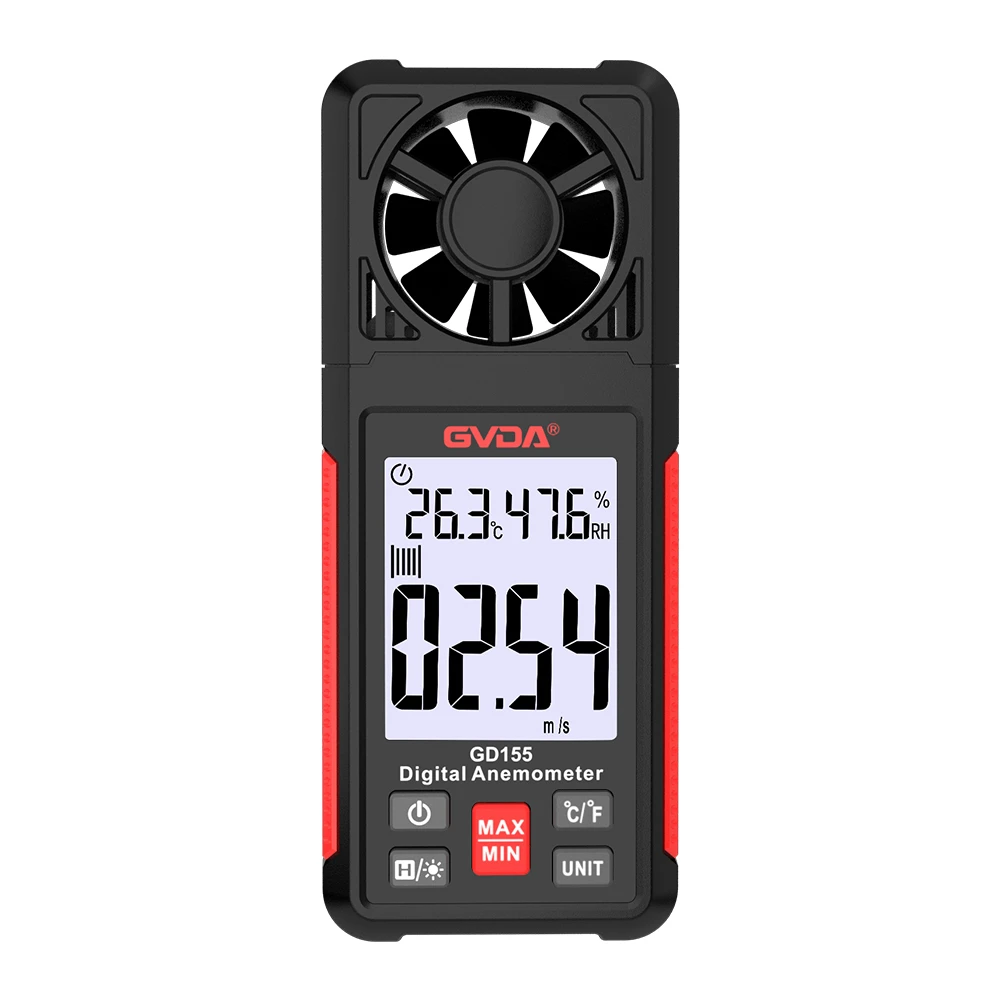
Rotary probe of anemometer
The working principle of the rotating wheel probe of the anemometer is based on converting the rotation into an electrical signal. First, through a proximity induction head, the rotation of the rotating wheel is "counted" and a pulse series is generated, and then converted by the detector. Get the speed value. The large-diameter probe (60mm, 100mm) of the anemometer is suitable for measuring turbulent flow with medium and small flow velocity (such as at the pipe outlet). The small-diameter probe of the anemometer is more suitable for measuring the airflow with the cross-section of the pipeline more than 100 times larger than the cross-section of the expedition head.
Features
Anemometer 1. Small size, little interference to the flow field;
2. Wide range of applications. Can be used not only for gases but also for liquids, in subsonic, transonic and supersonic flows of gases
3. High frequency response, up to 1 MHz.
4. High measurement accuracy and good repeatability. The disadvantage of the hot wire anemometer is that the probe interferes with the flow field to a certain extent, and the hot wire is easy to break.
5. In addition to measuring average velocity, pulsation and turbulence can also be measured; in addition to unidirectional motion, velocity components in multiple directions can be measured simultaneously.