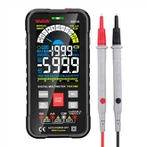
Q&A on Basic Knowledge of Using a Digital Multimeter
What is the function of the buzzer?
Answer: The buzzer function is an additional feature of the multimeter, generally available in the 2KΩ range. Usually, when measuring a circuit (or resistor) with a resistance value of less than 50Ω, the built-in buzzer will sound. In practice, this function is of great significance. It can improve the work efficiency of measuring the continuity of a circuit and is an essential function for electronic maintenance.
Why doesn't the digital multimeter return to zero when short-circuited in the 200Ω range?
Answer: In the 200Ω range, due to the resistance values existing in the circuit, the internal resistance of the meter, and the contact points, it is normal to have some remaining digits when short-circuited. This remaining digit will gradually increase during use and cannot be adjusted. However, you can reduce the value by cleaning the circuit board and ensuring tight contact points. You can short-circuit the multimeter first during use, write down the value, and then subtract it during the measurement.
How can we determine if the multimeter is in good condition?
Answer: This is a relatively complex issue. A good way is to test each function range. When detecting, you first need to find a detection source. However, it is impossible for ordinary users to have a standard detection source at home. So, for general detection, you can use a method that combines qualitative and a bit of quantitative measurement. The basic plan is to find a detection source and then use the multimeter according to the instruction manual.
How to calibrate the multimeter?
Answer: Just like other measuring instruments, multimeters are calibrated by the manufacturer before leaving the factory. Therefore, if there are no obvious major problems, please do not calibrate it casually. In modern multimeters, the meter head is generally a voltmeter. So, when calibrating other ranges, you must first calibrate the DC voltage range. This range is what professionals in the industry call the basic range. Once this range is inaccurate, basically, each range and each function (except the resistance range) may be inaccurate. Generally, a multimeter will have a potentiometer set for each function (such as the DC voltage range) or multiple potentiometers (such as the temperature range), and there are also some without potentiometers (such as the resistance range). If there is a potentiometer, it is easy to handle. Just input the detection signal and then calibrate it directly. If there is no potentiometer, it generally will not be inaccurate. In case of inaccuracy, it may be caused by damage to the meter or poor circuit contact.