Questions and Answers Regarding Wood Moisture Meters
Question 1: Why should I use a wood moisture meter?
This is probably the most frequently asked question among first-time hygrometer users. While specific answers to this question may vary by industry, those answers are often related to quality.
Using a wood moisture meter, you can accurately assess the problems that a given sample of wood may be experiencing, such as cracking, shrinkage, splitting, mold growth, and more. When the moisture content of wood is too high (or even too low, in some cases), the quality of the final product can suffer.
Using a moisture meter will help you ensure that the moisture content of the wood material you are using is within the correct %MC range to avoid future callbacks.
Question 2: What are the different types of wood moisture meters?
While there are countless hygrometer models on the market, and new ones appear all the time, they fall into two categories based on their operation:
Pitch.
Needle-free rice.
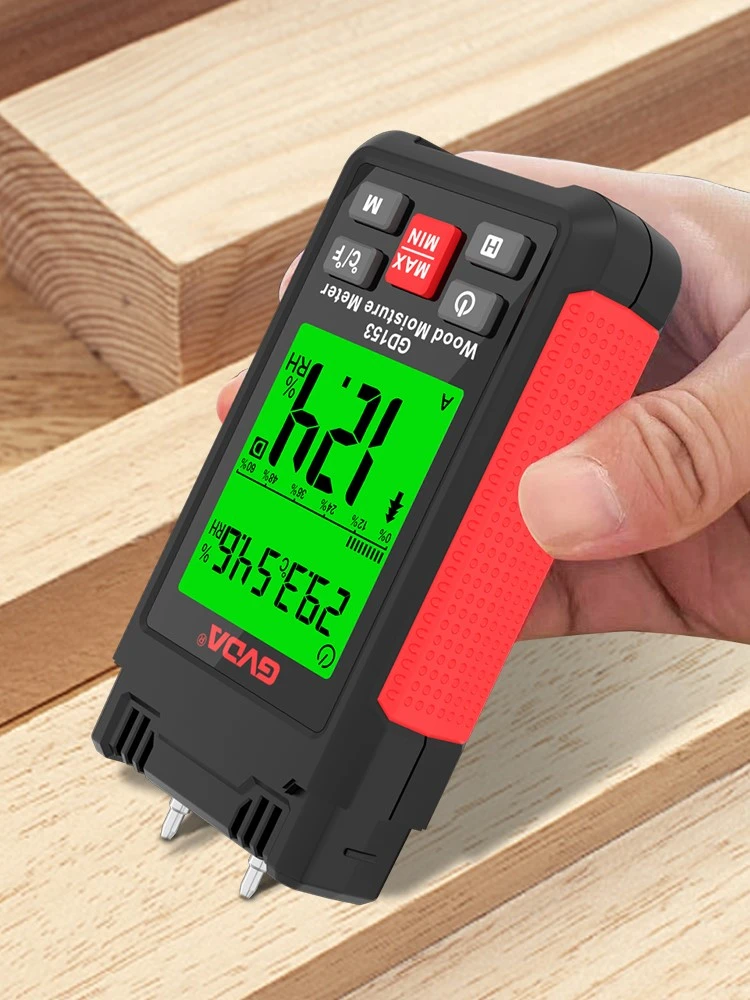
A pin hygrometer uses two (or more) electrodes to penetrate the wood material to read the %MC of that material using the principle of resistance. In a two-pin meter, one pin sources current and the other receives current, and the meter interprets the resistance of the current against the current. Since wood is an insulator and water is a conductor, the less resistance to electrical current, the higher the wood's moisture content.
Pinless meters, on the other hand, use electromagnetic radio waves to scan a sample of wood beneath the meter scan plate. These gauges are sometimes called non-intrusive moisture meters because they don't have to physically penetrate the wood surface to get a reading.
Question 3: Which type of moisture analyzer is better?
After asking about the different kinds of moisture meters, most people also want to know which moisture meter is the best type. The answer depends largely on the type of work you're doing, the size of the wood material you're working with, whether you're leaving pinholes in the material, and your personal preference.
The needleless meter is fast and will not damage the surface of the material being scanned. Pins, on the other hand, can give you more specific information about the moisture distribution in the wood.
Many professionals use both types of meters in their work, switching between the two as necessary.