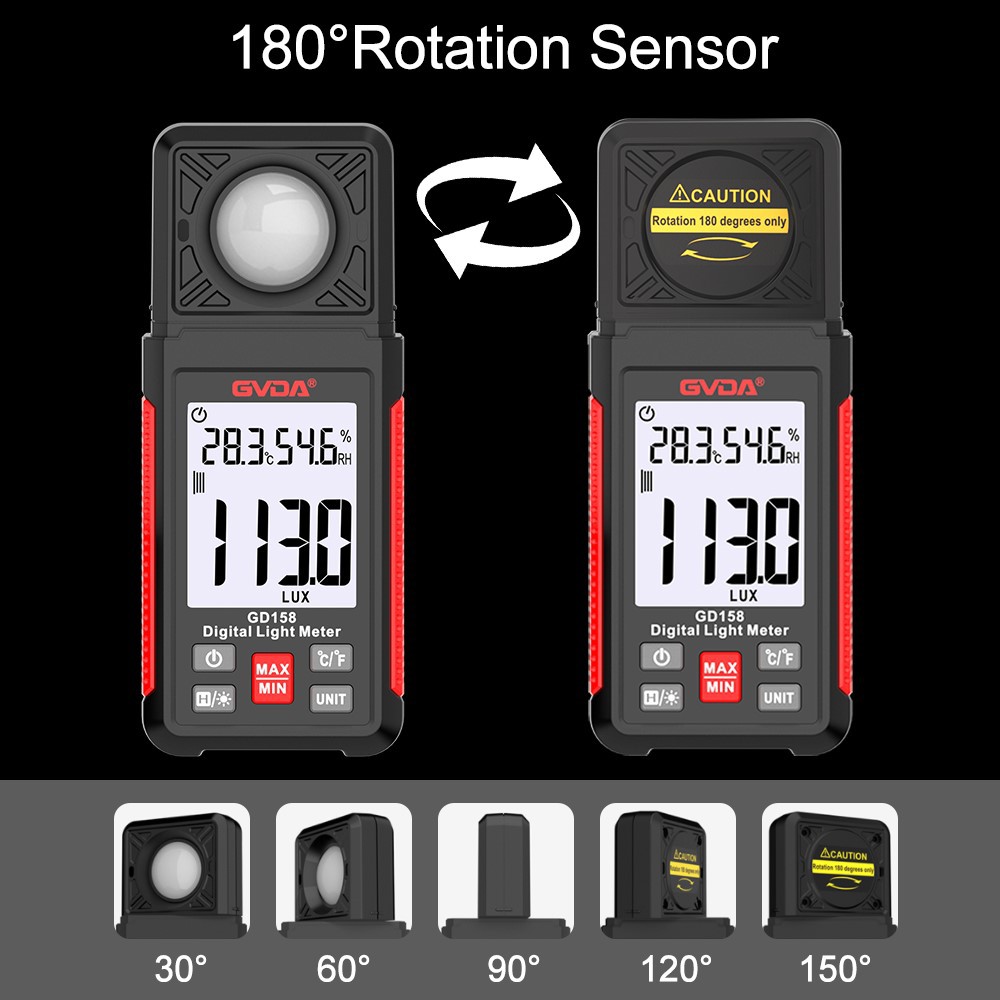
Relevant introduction and working principle of light meter
1. Illuminometer:
An lux meter, also known as a lux meter, is a specialized instrument for measuring luminosity and brightness. It is to measure the intensity of light (illuminance)
It is the degree to which an object is illuminated, that is, the ratio of the luminous flux obtained on the surface of the object to the illuminated area. An illuminance meter is usually composed of a selenium or silicon photovoltaic cell and a microampere meter.
2. Measurement principle:
A photovoltaic cell is a photoelectric component that directly converts light energy into electrical energy. When light is incident on the surface of the selenium solar cell, the incident light passes through the metal thin film 4 and reaches the interface between the semiconductor selenium layer 2 and the metal thin film 4, generating a photoelectric effect at the interface. The magnitude of the generated photocurrent is proportional to the illuminance on the surface of the photovoltaic cell receiving light. At this point, if an external circuit is connected, a current will flow through, and the current value will be indicated on a microampere meter with lux (Lx) as the scale. The magnitude of photocurrent depends on the strength of the incident light. The illuminance meter has a gear shift device, so it can measure both high and low illuminance.
Types of illuminance meters: 1. Visual illuminance meter: inconvenient to use, low accuracy, rarely used. 2. Optoelectronic illuminance meter: commonly used selenium solar cell illuminance meter and silicon solar cell illuminance meter.
Overview of Illuminometer
An illuminance meter is an optical testing instrument used to measure the intensity of artificial and natural light. It solves the problem of continuous measurement of light intensity and automatic recording. It consists of a light detector, an automatic shifting amplifier circuit, a curve recording device, a digital printing device, and an instantaneous digital display device. The curve recording device adopts a frictionless recording method using optical fibers, and the light detector is composed of a filter and a blue silicon photovoltaic cell, making the visible spectrum response curve conform to the human visual spectrum curve specified by the International Commission on Illumination (CIE). A pocket electronic illuminance meter belongs to the field of illuminance measurement technology and is suitable for measuring illuminance in agricultural production, daily life, and outdoor travel. It uses photoresistors as photoelectric conversion devices and contains a DC power supply. The voltage conversion circuit, switch, photoresistor, testing circuit, A/D converter, decoder, display driver, and display are sequentially connected in series at the output terminal of the DC power supply. This utility model avoids the use of a photometric head, and only requires a 3V battery for the DC power supply. The decoder, display driver, and display are integrated on one integrated circuit card, making it simple in structure, small in size, easy to move, and has the advantages of sensitive response. A UV radiometer, belonging to optical testing instruments. Its feature is a dual path detector composed of two unidirectional cut-off optical filters and two identical photoelectric receivers. The circuit part adopts dual path amplification, which can accurately measure the radiation value of the required test band, and has strong stray light cutoff.