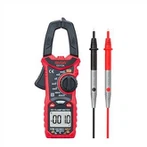
Resistance measurement with digital display multimeter
With the emergence of digital display multimeters, measurement has become more convenient. Pointer multimeters are still widely used due to their simple structure, high cost-effectiveness, and intuitive measurement performance. Below is a detailed introduction to its resistance measurement method:
Choose the appropriate magnification gear: When measuring resistance, it is advisable to select the magnification gear so that the pointer stays on the thinner part of the scale line. The closer the pointer is to the middle of the scale, the more accurate the reading will be; The further to the left, the tighter the scale line becomes, and the worse the reading accuracy. The magnification gear should be smaller than the measured value.
Zeroing: Before measuring resistance, the test probes should be touched together, and the colleague should rotate the "zeroing knob" (the larger knob on the right edge of the multimeter as shown in the figure on the right) so that the pointer just points to the zero position of the ohm scale. This step is called "zeroing" in the ohm range. Before changing the magnification gear to measure the resistance, it is essential to repeat this step to ensure accurate measurement. If the pointer cannot be adjusted to the correct position, it indicates that the battery voltage is insufficient or there is a problem with the instrument circuit.
Cannot measure resistance with electricity: When measuring resistance, the multimeter is powered by a battery, and the measured resistance cannot be charged because charged measurement is equivalent to connecting an additional power source, which not only fails to obtain correct measurement data, but may also damage the meter head. The actual value of the measured resistance is obtained by multiplying the multiplication factor by the pointer reading. If the resistance reading is 25 when measured at a magnification of 1000, then the resistance value of the measured resistor is 25 × 1000=25000 ohms.
To determine the quality of a diode using the ohm range of a multimeter, please refer to this article titled "Positive and Negative Poles of a Diode and Their Quality Determination".