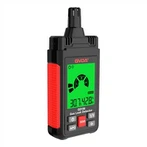
Selection and Use of the Anemometer Probe
There are usually three methods for measuring wind speed: thermal probe, impeller probe, and Pitot tube. So how can we choose the most suitable instrument for us to use when measuring wind speed? In what situations are each of these three measurement methods suitable for use?
In the flow velocity measurement range of 0 to 100m/s, we can divide it into three sections: low speed: 0 to 5m/s; medium speed: 5 to 40m/s; high speed: 40 to 100m/s. The thermal probe of the anemometer is used for measurements from 0 to 5m/s; the impeller probe of the anemometer is ideal for measuring flow rates from 5 to 40m/s; and the pitot tube is used to obtain the best results in the high-speed range.
1. Thermal probe has accurate measurement effect, and the wind speed range is generally 0-30m/s.
2. The impeller probe can select the diameter of the impeller, and impellers of different sizes have different applications. If you choose a large impeller with a diameter of 100mm, you can measure the average wind speed in a circular area with a diameter of 100mm. In addition, the impeller probe can also be attached with a cover to achieve the effect of measuring the air volume of small air outlets.
3. Pitot tubes are generally used to measure wind speed in pipelines and are suitable for large wind speeds. Generally, Pitot tubes are not recommended for wind speeds less than 5m/s.
An additional criterion for the correct selection of anemometer probes is temperature: usually the operating temperature of the thermal sensor of an anemometer is about -20~70˚C. Ordinary impeller probes are also around -20~70˚C, but impeller probes can be specially made to withstand high temperatures of 350˚C. Pitot tubes have the widest range of temperature applications, and even the most ordinary probes can withstand high temperatures of 600˚C.
The correct adjustment position of the anemometer's impeller probe is that the airflow direction is parallel to the impeller axis. When the probe is gently rotated in the air flow, the indication value will change accordingly. When the reading reaches the maximum value, the probe is in the correct measuring position. When measuring in a pipeline, the distance from the starting point of the straight part of the pipeline to the measurement point should be greater than 0XD. The impact of turbulent flow on the thermal probe and pitot tube of the anemometer is relatively small.
After introducing the three measurement methods of anemometer, I believe you already have a preliminary idea on how to choose an anemometer.