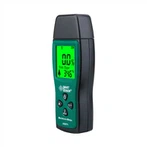
Several conditions for selecting infrared thermometers
1. Measurement temperature range: The temperature measurement range is the most important performance indicator of an infrared thermometer. Each model of thermometer has its own specific temperature measurement range. It is recommended that you choose an appropriate range of infrared thermometer according to your measurement needs. The temperature range to be measured must be considered accurately and comprehensively, neither too narrow nor too wide. If the temperature range is too wide, it will reduce the accuracy of temperature measurement, and if the temperature is too high, the price will be expensive, which is not cost-effective economically; The temperature is too low to meet the requirements. According to the blackbody radiation law, the change in radiation energy caused by temperature in the short band of the spectrum will exceed the change in radiation energy caused by emissivity error. Therefore, short waves should be used as much as possible for temperature measurement. Generally speaking, the narrower the temperature measurement range, the higher the resolution of the output signal for monitoring temperature, and the easier it is to solve the problem of accuracy and reliability.
2. Measurement accuracy and minimum resolution: Measurement accuracy and resolution are two different concepts that can be easily confused. Measurement accuracy is the only indicator to ensure the accuracy of measurement, and it is also a key indicator to determine the performance of infrared thermometers. Resolution is the minimum measure used to measure a specific temperature.
3. Emissivity: According to customer feedback, measurement deviations often occur when using infrared thermometers, with emissivity being the main cause of errors in 50% of cases. Due to the fact that infrared thermometers are suitable for various occasions, the material and color of the surface of the object being measured are different (especially for various pipelines in HVAC systems), and their ability to emit infrared energy to the outside world is also different. By adjusting the emissivity, measurement errors caused by materials can be reduced. So whether the instrument has this function is crucial (see the article "Introduction to the Application of Infrared Thermometers in Marine Instruments" for details).
4. Target size: i.e. spot size, which is the area of the measuring point of the thermometer. The farther you are from the target, the larger the size of the light spot. Infrared thermometers can be divided into monochrome thermometers and two-color thermometers (radiation colorimetric thermometers) based on their principles. For monochrome thermometers, the area of the measured target should fill the thermometer's field of view during temperature measurement. It is recommended that the size of the target being tested exceed 50% of the field of view size. If the target size is smaller than the field of view, background radiation energy will enter the thermometer and interfere with the temperature reading, causing errors. On the contrary, if the target is larger than the field of view of the thermometer, the thermometer will not be affected by the background outside the measurement area. For a colorimetric thermometer, its temperature is determined by the ratio of the radiated energy within two independent wavelength bands. Therefore, when the target being measured is very small, does not fill the field of view, and there is smoke, dust, or obstruction on the measurement path that attenuates the radiation energy, it will not affect the measurement results. Even when the energy has decayed by 95%, the required temperature measurement accuracy can still be guaranteed. For small targets that are in motion or vibration, a colorimetric thermometer is the best choice because the diameter of the light is small, flexible, and can transmit radiation energy through curved, obstructed, and folded channels. It can measure targets that are difficult to approach, have harsh conditions, or are close to electromagnetic fields.