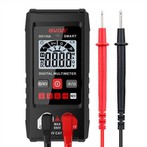
Several points when choosing a digital multimeter
(1) Reliability: Especially under harsh conditions, reliability is more important than ever.
(2) Accuracy: The primary consideration in the design of digital multimeters, especially those that have been independently tested by certified laboratories and printed with the marks of testing laboratories such as UL, CSA, and VDE.
(3) Resolution: Resolution, also called sensitivity, refers to the smallest quantitative unit of the measurement results of a digital multimeter, that is, small changes in the measured signal can be seen. For example: If the resolution of a digital multimeter is 1mV in the 4V range, then when measuring a 1V signal, you can see a small change of 1mV. The resolution of a digital multimeter is generally expressed in digits or words.
The resolution of a digital multimeter is a very important indicator. For example, if you want to measure a length less than 1 mm, you will definitely not use a ruler with the smallest unit being centimeters; or if the temperature is 98.6°F, then it is okay to measure it with a thermometer that only has integer markings. To use it, you need a thermometer with a resolution of 0.1°F.
(4) Accuracy: refers to the maximum allowable error under a specific use environment. In other words, accuracy is used to indicate how close the measurement value of the digital multimeter is to the actual value of the signal being measured. For digital multimeters, accuracy is usually expressed as a percentage of the reading. For example, a 1% reading accuracy means that when the digital multimeter displays 100.0V, the actual voltage may be between 99.0V and 101.0V. In the detailed instructions, there may be a specific value added to the basic accuracy. Its meaning is the number of words to be added to transform the right end of the displayed *. In the previous example, the accuracy might be stated as ±(1%+2). Therefore, if the multimeter reads 100.0V, the actual voltage will be between 98.8V and 101.2V. The accuracy of an analog meter (or analog multimeter) is calculated based on the error over the full scale, not the displayed reading. The typical accuracy of an analog multimeter is ±2% or ±3% of full scale. The typical basic accuracy of a digital multimeter is between ±(0.7%+1) and ±(0.1%+1) of reading, or even better.
(5) Ohm's Law: Ohm's Law reveals the relationship between voltage, current, and resistance. Applying Ohm's law, the voltage, current, and resistance of any circuit can be calculated: voltage = current × resistance. So just knowing any two values in the formula can calculate the third value. A digital multimeter applies Ohm's law to measure and display resistance, current, or voltage.
(6) Digital and analog pointer display: In terms of accuracy and resolution, digital display has good advantages. The measured value can be displayed with three or more digits. Analog pointers are slightly inferior in accuracy and resolution, and we generally rely on estimating the position of the pointer to take readings. A digital multimeter has a bar graph that displays signal changes and trends like an analog pointer, but it is more durable and reduces damage