Skills and precautions in actual circuit welding:
1) Connector
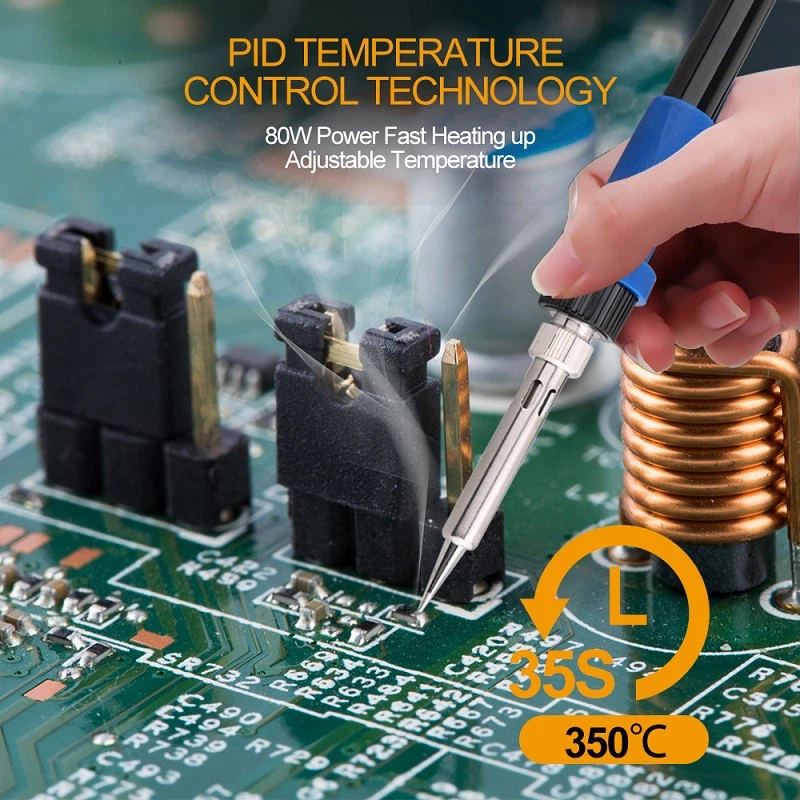
Set the temperature of the soldering station to 370 degrees, insert the component into the corresponding PCB hole, make the component pins perpendicular to the PCB pad as far as possible, the soldering iron tip is at a 45-degree angle to the PCB, and the soldering iron tip is against the component pins and the pad Preheat, and then start to feed the solder wire. When the solder wire melts, the speed of tin feeding should be mastered. When the entire pad is melted, stop and remove the tin wire. Finally, cut off the excess pins with diagonal pliers.
2) SMD component welding
The soldering of SOP8 and SOP16 is relatively simple. Align the chip with the PCB pad, fix one pin first, and after confirming that the other pins are also aligned with the corresponding pad, solder the remaining pins in turn. Drag welding is also possible.
But for the package welding of LQFP48, it is impossible to weld the pins one by one, and the efficiency is too low. You can align the chip with the PCB pins first, fix one pin first, and then fix the diagonal pin. After the fixation is completed, apply an appropriate amount of flux to the surrounding pins. Then, use the tip of the soldering iron to perform drag soldering. After the drag soldering is completed, use an electronic magnifying glass to check the soldering quality and confirm that there is no lead soldering.
If you use a soldering iron to solder QFN-24, it is more troublesome, and you need to use a heat gun or a heating platform to solder this type of chip.
The MHP30 mini heating platform is used in the video. Because there is no stencil, the solder paste can only be spread evenly by hand. After the coating is completed, align the chip with the PCB pad, set the temperature of the heating platform to 190 degrees, and solder the PCB. Align the position with the heating platform and start heating. You can see that the solder paste gradually starts to melt, and the process is very decompressed. After the solder paste is completely melted, slowly remove the PCB, let it stand and wait for natural cooling. After the cooling is completed, use an electronic magnifying glass to check Soldering quality, found that there is excess solder connected to the solder, at this time use an electric soldering iron to take away the excess solder, confirm again that there is no lead solder, and the soldering is completed.
3) Special PCB soldering
For students and friends, universal board welding skills are very important in the competition. The quality of welding may affect the progress of the competition and even the quality of the function. You can watch the above video about the welding of the universal board.
Finally, let’s talk about special PCB welding, which means aluminum substrate. Aluminum substrate is a metal-based copper clad laminate with good heat dissipation function. Generally, a single panel is composed of three layers, which are the circuit layer (copper foil) , insulating layer and metal base layer, common in LED lighting products. Due to the very good thermal conductivity of the aluminum substrate, it is difficult to solder with an electric soldering iron. Usually, the manual welding of the aluminum substrate requires the use of a hot bed to assist the electric soldering iron or directly use a heating table for manual reflow soldering, and the soldering temperature should not be too high. The soldering time is Within 20 seconds.