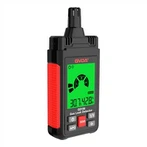
Smart use of low voltage test pen
An auxiliary safety tool that is frequently utilized is a low-voltage electroscope. It is used to check the liveness of electrical equipment's casings and wires below 500 volts. An everyday low-voltage electroscope is portable, and if you understand how they work and are familiar with electrical theory, you may apply a variety of abilities very quickly.
(1) The formula for judging alternating current and direct current
The electric pen judges AC and DC, AC is bright and DC is dark,
The AC neon tube is bright through the whole body, and the DC neon tube is bright at one end.
illustrate:
First of all, remind the readers that the test on the charged body must be confirmed before using the low-voltage test pen, and that it should not be used until that has been done. It is clear that the "two powers" are being compared when assessing AC and DC power. Both ends of the neon tube light up simultaneously when measuring alternating current, and only one end of the neon tube lights up brightly when measuring direct current.
(2) The formula for judging the positive and negative electrodes of direct current:
The electric pen judges the positive and negative poles, and the neon tube should be observed carefully.
The bright front is negative, and the bright rear is positive.
illustrate:
The front end of the neon tube refers to the tip of the test pen, and the rear end of the neon tube refers to the end of the hand. The bright front end is the negative electrode, and vice versa. Attention should be paid to the test: the voltage is 110V and above; if the person is isolated from the large, one hand touches either pole of the power supply, the other holds the measuring pen, the metal tip of the electric pen touches the other pole of the power supply to be tested, and the front end of the neon tube emits If it is bright, the measured contact source is the negative pole; if the back end of the neon tube is very bright, the measured contact source is the positive pole. This is the principle of DC unidirectional flow and the flow from the negative pole to the positive pole.
(3) Judging whether the DC power supply is connected or not, and the formula to distinguish the positive and negative poles
The DC coefficient of the substation, the electric pen does not light up;
If the light is close to the pen, the positive pole is faulty;
If the light is close to the finger end, connect the faulty negative pole.
illustrate:
The DC coefficient of power plants and substations is for insulation. People stand on it and touch the positive or negative pole with an electroscope. The neon tube should not be lit. If it is luminous, it means that the DC system is connected; the light is close to the tip of the pen. , it is the positive connection; when the light is close to the end of the finger, it is the negative connection.
(4) The formula for judging in-phase and out-of-phase
Judging that two lines are the same and different, hold a pen in each hand,
The two feet are insulated from the phase, and each of the two brushes touches a key line.
Look at a pen with your eyes, if it doesn't shine, it's different.
illustrate:
During this test, remember that the two feet must be insulated from each other. Most of the power supply in my country is 380/220V, and the transformer is generally connected directly with the neutral point. When doing the test, the human body and the large must be insulated to avoid forming a loop, so as to avoid misjudgment; during the test, the two strokes are on and off. The same, so just look at one.
(5) The formula for judging the fault of the phase line of the 380/220V three-phase three-wire power supply line
Star connection three-phase line, the electric pen touches two lights,
The remaining one is weak in brightness, and the phase wire has been connected;
If there is almost no light, the metal connection is faulty.