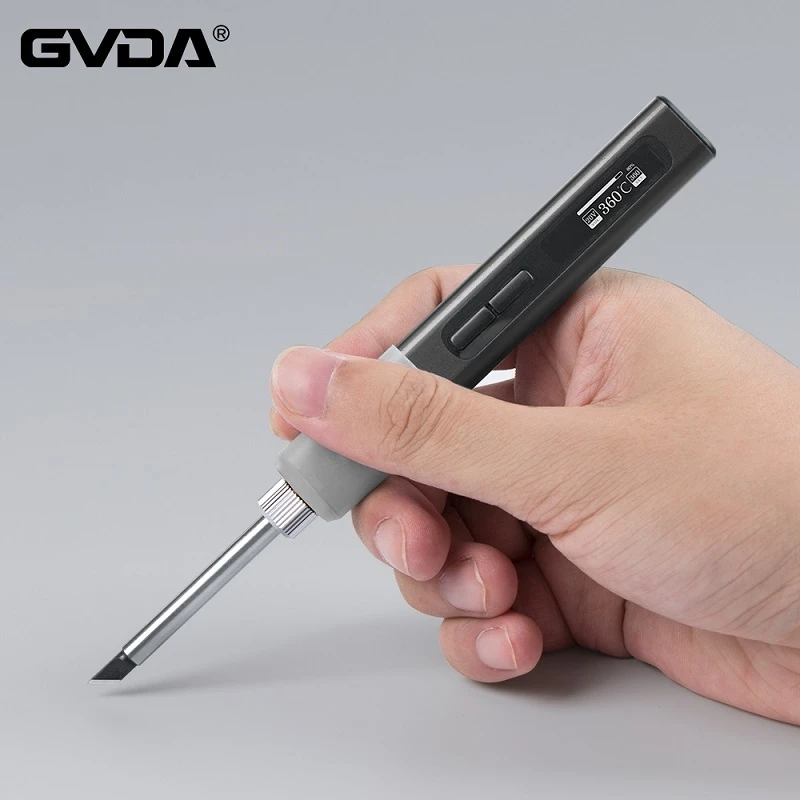
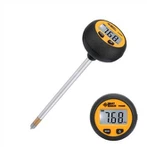
Soldering Iron Thermometer Features Soldering Iron Thermometer Principle
Features of Soldering Iron Thermometer
0.2m CA can accurately and quickly measure the temperature, suitable for lead-free soldering.
According to the shape of the soldering tip can be arbitrary with any angle to measure the temperature of the soldering tip.
Automatic power off function, when not in use for 3 minutes, the power will be automatically turned off.
With [MAXHOLD] to record the highest temperature of the soldering tip, when pressing the [MAXHOLD] button, the display will show the highest temperature record of the soldering tip.
Accurate and fast determination of the tip temperature by CA sensor.
Clear digital display.
Special alloy coating makes the sensor resistant to corrosion and oxidation.
Sensor is easy to replace.
Principle of Soldering Iron Thermometer
Soldering iron thermometer is composed of temperature sensing wire and meter. The sensing wire is a K thermocouple, output voltage signal, through the instrument detection, converted into temperature value. Thus, on the digital display screen, the precise temperature is displayed.
DIY soldering iron thermometer
Soldering iron thermometer is composed of temperature sensing wire and meter.
If you have a digital multimeter on hand that can measure the temperature, and the probe is a thermocouple, it is very convenient. Because generally this thermocouple is also a K-type, it is good to directly connect the output of the temperature sensing wire to the temperature input of the multimeter! The temperature is displayed directly.
If the hand of the digital multimeter can not measure the temperature, then you can only use its 200mV gear to measure the voltage, and then check the table, converted to temperature values.
Temperature-sensitive line can be used with a white light 191 thermometer, with as long as the use of a good. Sensitive line belongs to the consumable materials, with about 50 times to replace a to ensure accuracy, so it is easy to buy.
Temperature-sensitive line is the Mercedes-Benz trademark shape, the center of a temperature-sensitive block, leading to three lines, the end of a circle used to connect the terminal. In fact, it is made of two lines, there are red sets of positive lines, blue sets of negative lines, there is a side of the two lines are entangled together, not as a signal line, mainly used as a support, because the three sides can be supported firmly.
The main job is to make the shelf for the sensing wire.
Buy 3 terminal blocks. When the threads of the terminal block are larger than the loop of the lead wire of the temperature sensing wire, remove the small loop of the lead wire and rewind a large loop according to the size of the threads of the terminal block.
Then take a waste circuit board, compared to the size of a good drill three holes, just a triangle, the terminal installed on the circuit board. Then the temperature-sensitive line three feet connected to the threads of each terminal, tighten the nut on it. And then welded on the line to the multimeter, it's good. As shown:
Temperature measurement, the soldering iron head first on a little tin, and then placed in the middle of the temperature-sensitive line on the temperature-sensitive block, tin surface and temperature-sensitive block horizontal contact, and a certain degree of strength. The temperature-sensitive block can be on the tin, so it can be in full contact with the soldering iron head, the measured temperature is more accurate. At this time, the temperature of the multimeter temperature gear directly shows the temperature.
If the measured voltage mV value, the following conversion table will be used to convert the voltage to temperature, plus room temperature, is the temperature of the soldering iron. For example, 12.6mV is 310℃, plus room temperature, such as 30℃, the temperature of the iron head is 340℃.
In addition, do not use the temperature-sensitive line, directly with the multimeter thermocouple to contact the iron head, is possible, that is, the multimeter thermocouple is not on the tin, so it can not be completely in contact with the iron head, it will be slightly smaller than the temperature value measured by the temperature-sensitive line, but generally only small 2-5 ℃ or so.