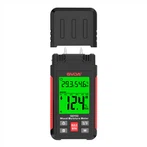
Solving common problems with digital illuminance meters
The digital illuminance meter is suitable for measuring light level in agricultural production, daily life and outdoor travelling. It adopts a photoresistor as a photoelectric conversion device, and it contains a DC power supply, a voltage conversion circuit, a switch, a photoresistor, a test circuit, an A/D converter, a decoder, a display driver, and a display in series in turn at the output of said DC power supply. The utility model avoids the use of photometric head, DC power supply can be used only 3V battery, decoder, display driver and display integrated in an integrated circuit card, so that its structure is simple, small size, easy to move, but also has the advantages of responsive and so on.
Digital illuminance meter structure principle:
1. Introduction to the test of illuminance
Illuminance is the surface density of the light flux received on the illuminated plane. Illuminance meter is used to measure the illuminance of the illuminated surface of the instrument, is one of the more used in the measurement of illuminance.
Digital illuminance meter use method:
1. Turn on the power.
2. Select the suitable measuring gear.
3. Open the light detection cover, and the light detector front to the light source to be measured.
4. Read the measured value on the illuminance meter display.
5. Read the measured value, such as the highest digit display "1" that is, overload, you should immediately select a higher level of measurement.
6. Data hold switch, switch to "HOLD", LCD display "□" symbol, and the display value is locked, switch to "NO", you can cancel the reading lock function. The reading lock function can be cancelled by turning the switch to "NO".
7. After the measurement work is finished, please cover the light detector well and switch to "OFF" to turn off the power of the instrument.
Digital illuminance meter care and maintenance:
1. Do not measure under high temperature and high humidity.
2. When using, the light detector should be kept clean.
3. The light source test reference alignment at the top of the light receiving sphere.
4. The sensitivity of the light detector will be reduced by the conditions of use or time, it is recommended that you do regular calibration of the instrument to maintain the basic accuracy.