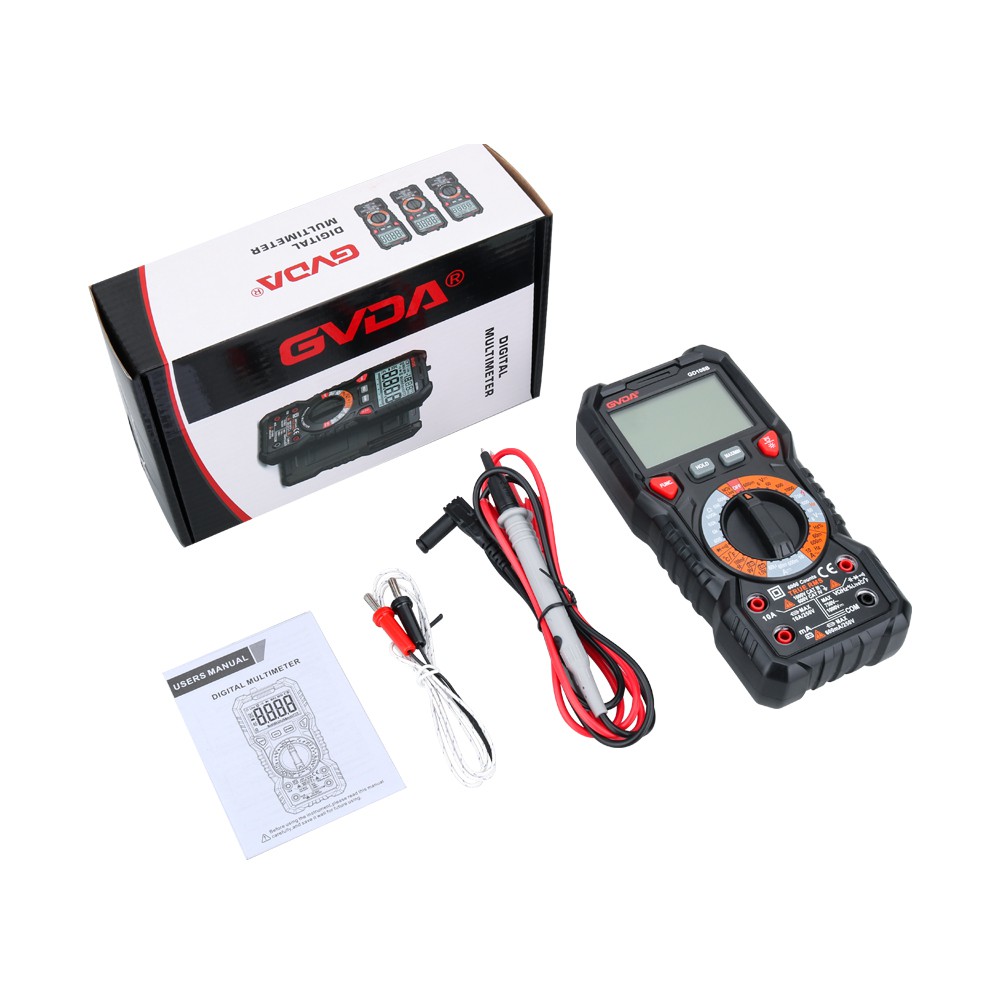
Some measurement methods of multimeter
Before use, check whether the pointer points to the mechanical zero position. If it does not point to the zero position, you can turn the zero adjuster on the cover to make the pointer point to the zero position.
Insert the red and black plugs of the test rod into the + - sockets respectively. For example, when measuring AC, DC 2500V or DC 5A, the red plugs should be inserted into the sockets marked 2500 or 5A respectively.
1, DC current measurement
When measuring 0.05~500mA, turn the switch to the desired current level, when measuring 5A, turn the switch to the 500mA DC current limit and then connect the test rod in series to the circuit under test.
2, AC and DC voltage measurement
When measuring AC 10~1000V or DC 0.25~1000V, turn the switch to the required voltage range. When measuring AC/DC 2500V, turn the switch to the position of AC 1000V or DC 1000V respectively, and then connect the test rod across the two sides of the circuit under test. end.
3, DC resistance measurement
Install the battery (R14 type 2#1.5V and 6F22 type 9V each). Turn the switch to the desired resistance level, short the two ends of the test rod, adjust the zero ohm adjustment knob, and make the pointer point to the ohm 0 position (If the ohm zero position cannot be indicated, it means that the battery voltage is insufficient and the battery should be replaced), then connect the test rod across the two ends of the circuit under test for measurement.
When measuring the resistance accurately, the appropriate resistance gear should be selected so that the pointer can point to the middle third of the dial as much as possible.
When measuring the resistance in the circuit, the power supply of the circuit should be cut off first, and if there is a capacitor in the circuit, it should be discharged first.
When checking the leakage resistance of the electrolytic capacitor, you can turn the switch to the R×1K position, the red rod of the test rod must be connected to the negative pole of the capacitor, and the black rod to the positive pole of the capacitor.
4, audio level measurement
On a certain load impedance, it is used to measure the gain of the amplifier and the loss of the line transmission, and the measurement unit is expressed in decibels
The relationship between audio level and power voltage is:
NdB=10log10P2/P1 =20log10V2/V1
The scale factor of the audio level is designed according to the standard of 0dB=1mW600Ω transmission line.
That is V1=(PZ)1/2=(0.001*600)1/2=0.775V
P2V2 is the measured power or the measured voltage respectively
The audio level is based on AC 10V. If the indicated value is greater than +22 dB, it can be measured above 50V. The indicated value can be corrected according to the value shown in the table below.