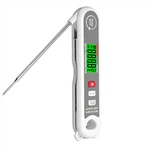
Some tips on using the test pen
The test voltage range of the test lead is usually between 60 and 500 volts.
The electric test pen is composed of a metal body at the pen tip, a resistor, a neon tube, a pen body, a small window, a spring and a metal body at the end of the pen. When the electric test pen tests the electrified body, as long as the electrified body, the electric pen, the human body, and the earth form a path, and the potential difference between the electrified body and the earth exceeds a certain value (for example, 60 volts), the neon tube in the electric test pen will emit light ( Whether its potential is AC or DC), this tells people that the measured object is charged and exceeds a certain voltage intensity.
When using the test lead, the part where the human hand touches the test lead must be the metal at the top of the test lead, not the metal probe at the front end of the test lead. Use the test pen to backlight the small window of the neon tube so that you can see the red light emitted when the charged body is charged. After holding the pen, generally use the thumb and forefinger to touch the top metal, touch the test point with the tip of the pen, and observe whether the neon tube emits light at the same time. If the neon tube of the test pen glows weakly, it must not be concluded that the voltage of the electrified body is not high enough. It may be that the test pen or the test point of the electrified body is dirty, or the ground wire of the electrified body is tested. Select a test point. After repeated tests, if the neon tube is still off or slightly bright, it is finally confirmed that the test object is not charged.
The method of using the test pen is extremely important, and there are certain rules for holding the test pen. Tell people what is right and what is wrong when using a test lead. Using the wrong way to hold the pen to test the electrified body will cause electric shock accidents, so special attention must be paid.
The principle of the electric pen
1. Ohm's law: I=U/R;
2. The total resistance relationship of the series circuit: R=R1+R2;
3. The structure and characteristics of the test pen.
The specific instructions are as follows:
A. When the electric pen is used to detect whether a certain conductor is live or neutral, the current passing through the electric pen (that is, the current through the human body) I = the total voltage U applied at both ends of the electric pen and the human body, divided by (/equivalent Fractional line) to measure the total resistance R between the electric pen and the two ends of the human body.
B. When measuring the live wire, the lighting circuit has a voltage of about U=220V between the live wire and the ground. The resistance of the human body is generally small, usually only a few hundred to a few thousand ohms, and the internal resistance of the test pen is usually about several megohms. The current of the test pen (that is, the current through the human body) is very small, usually less than 1 mA. When such a small current passes through the human body, it will not harm people, and when such a small current passes through the neon bulb of the test pen, the neon bulb will will shine.
C. When measuring the zero line, U=0, I=0, that is, no current passes through the neon bulb of the test pen, and of course the neon bulb does not emit light. In this way, we can judge whether the live wire or the neutral wire is based on whether the neon bulb glows.