Sound Level Meter Basics
The inherent irregular motion and mutual repulsion of air molecules create a static force, which is called atmospheric pressure. Sound is the vibration of air molecules, and the vibrating air molecules generate additional pressure on the cross-section they pass through, which is called sound pressure. The sound pressure is much smaller than atmospheric pressure. Generally, sound pressure level is used to describe the size of sound. That is, a very small sound pressure p0=2 x 10⁻⁵ Pa is used as the reference sound pressure. The value obtained by multiplying the ratio of the measured sound pressure p to the reference sound pressure p0 by 20 is called sound pressure level, and the unit is decibels (db). Decibel (dB) is named after American telephone inventor Bell, as the unit of decibel is too large, it is used to represent 1/10 of a decibel. The calculation of decibels is not a linear proportion, but a logarithmic proportion. When using decibels to describe sound, the frequency needs to be given at the same time.
Principle and composition of sound level meter
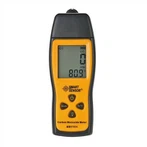
A sound level meter is a fundamental instrument in noise measurement, typically consisting of a microphone, preamplifier, attenuator, amplifier, frequency weighting network, and effective value indicator head.
The working principle of a sound level meter is that the sound is converted into an electrical signal by a microphone, and then the impedance is transformed by a preamplifier to match the microphone with an attenuator. The amplifier adds the output signal to the weighting network, performs frequency weighting on the signal (or an external filter), and then amplifies the signal to a certain amplitude through an attenuator and amplifier, and sends it to the effective value detector (or an external level recorder). The noise level value is displayed on the indicator head.
A microphone is a device that converts sound pressure signals into voltage signals, also known as a microphone. It is the sensor of a sound level meter. There are several common types of microphones, including crystal type, electret type, moving coil type, and capacitive type.
1.1 A dynamic coil microphone consists of a vibrating diaphragm, a movable coil, a magnet, and a transformer. After being subjected to acoustic pressure, the vibrating diaphragm begins to vibrate and drives the movable coil installed with it to vibrate in the magnetic field to generate induced current. The current varies according to the magnitude of the acoustic pressure applied to the vibrating diaphragm. The higher the sound pressure, the greater the generated current, and the lower the sound pressure, the smaller the generated current.
1.2 Capacitive microphone is mainly composed of a metal diaphragm and a metal electrode located very close to it, essentially a flat capacitor. The metal film and metal electrode form the two plates of a flat capacitor. When the film is subjected to sound pressure, it deforms, causing a change in the distance between the two plates and thus altering the capacitance. The voltage in the position measurement circuit also changes, achieving the function of converting sound pressure signals into voltage signals. Capacitive microphones are ideal microphones in acoustic measurements, with advantages such as large dynamic range, flat frequency response, high sensitivity, and good stability in general measurement environments, making them widely used. Due to the high output impedance of the condenser microphone, impedance transformation is required through a preamplifier, which is installed inside the sound level meter near the location where the condenser microphone is installed.