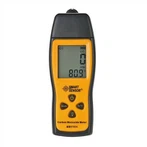
Sound level meter is the basic noise measuring instrument
The sound level meter is a basic noise measuring instrument. It is an electronic instrument, but it is different from objective electronic instruments such as voltmeters. When converting acoustic signals into electrical signals, the time characteristics of the human ear's response speed to sound waves can be simulated; the frequency characteristics with different sensitivities to high and low frequencies, and the intensity characteristics that change the frequency characteristics at different loudnesses. A sound level meter is a subjective electronic instrument.
Classification of sound level meters
According to the sensitivity of the sound level meter, there are two methods of sound level measurement: one is an ordinary sound level meter, which does not have high requirements for microphones. The dynamic range and frequency response flat range are narrow, and are generally used without band-pass filters; the other type is precision sound level meters, whose microphones require wide frequency response, high sensitivity, good long-term stability, and can be used with various Used together with a band-pass filter, the amplifier output can be directly connected to a level recorder or tape recorder, and the noise signal can be displayed or stored. If the microphone of the precision sound level meter is removed, replaced with an input converter and connected to an accelerometer, it becomes a vibration meter for vibration measurement.
Sound level meter is the basic instrument in noise measurement. Sound level meters generally consist of condenser microphones, preamplifiers, attenuators, amplifiers, frequency weighting networks, and effective value indicating meters. The working principle of the sound level meter is: the microphone converts the sound into an electrical signal, and then the preamplifier converts the impedance to match the microphone and the attenuator. The amplifier adds the output signal to the weighting network, performs frequency weighting on the signal (or external filter), and then amplifies the signal to a certain amplitude through the attenuator and amplifier, and sends it to the effective value detector (or external voltage detector). Level recorder), giving the value of the noise level on the indicator head.
There are three standard weighting networks for frequency weighting networks in sound level meters: A, B, and C. The A network simulates the human ear's response to the 40-square pure tone in the equal loudness curve. Its curve shape is opposite to the 340-square equal loudness curve, which causes greater attenuation in the mid- and low-frequency bands of the electrical signal. The B network simulates the human ear's response to a 70-meter pure tone, which attenuates the low-frequency band of the electrical signal to a certain extent. The C network simulates the response of the human ear to 100 square meters of pure tone, and has an almost flat response in the entire audio frequency range. The sound pressure level measured by the sound level meter through the frequency weighting network is called sound level. Depending on the weighting network used, it is called A sound level, B sound level and C sound level respectively. The unit is recorded as dB(A) , dB(B) and dB(C).