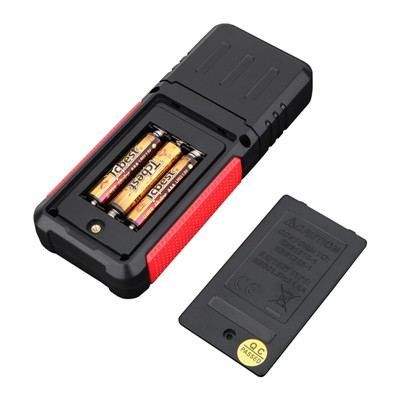
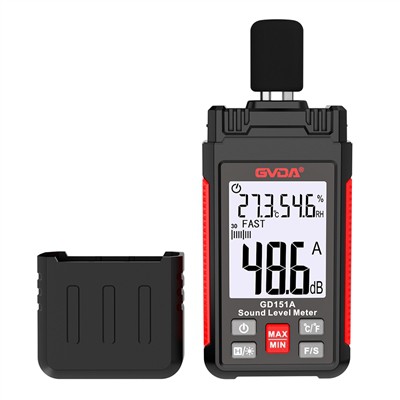
Specific classification description of anemometer
It is the most common type of anemometer. The rotary cup anemometer was first invented by Robinson Crusoe in England. At that time, it used four cups, and later it was changed to three cups. Three parabolic or hemispherical empty cups fixed on the frame at an angle to each other are aligned with one side, and the entire frame together with the wind cup is mounted on a shaft that can rotate freely. The wind cup rotates around its axis under the action of wind force, and its rotational speed is proportional to the wind speed. The rotational speed can be recorded using electrical contacts, tachometer generators or photoelectric counters.
propeller anemometer
It is an anemometer with a set of three or four blade propellers rotating around a horizontal axis. The propeller is installed at the front of a wind vane so that its rotating plane is always facing the direction of the wind, and its rotational speed is proportional to the wind speed.
Classification of anemometers
The rotary cup anemometer was first invented by Robinson Crusoe in England.
It was four cups, but later it was changed to three cups. Three parabolic or hemispherical empty cups fixed on the frame at an angle to each other are aligned with one side, and the entire frame together with the wind cup is mounted on a shaft that can rotate freely. Cup anemometer It is the most common type of anemometer. The rotary cup anemometer was first invented by Robinson Crusoe in England. At that time, it used four cups, and later it was changed to three cups. Three parabolic or hemispherical empty cups fixed on the frame at an angle to each other are aligned with one side, and the entire frame together with the wind cup is mounted on a shaft that can rotate freely. The wind cup rotates around its axis under the action of wind force, and its rotational speed is proportional to the wind speed. The rotational speed can be recorded using electrical contacts, tachometer generators or photoelectric counters. Xi'an Chaoxi Electronic Technology Co., Ltd. supplies various types of anemometers such as digital anemometers, multi-function anemometers, and intelligent pressure anemometers, which are used in Xi'an/Baoji/Hanzhong, Shaanxi, Lanzhou/Tianshui, Gansu, Yinchuan, Ningxia, Xining, Qinghai, Xinjiang and other northwest Regional anemometer suppliers.
propeller anemometer
It is an anemometer with a set of three or four blade propellers rotating around a horizontal axis. The propeller is installed at the front of a wind vane so that its rotating plane is always facing the direction of the wind, and its rotational speed is proportional to the wind speed. An anemometer is a metal wire heated by an electric current, and the flowing air dissipates heat. The heat dissipation rate is linearly related to the square root of the wind speed, and then linearized through electronic circuits (to facilitate scale and reading), an anemometer can be made. There are two types of wind speed meter: side heating type and direct heating type. The side heating type is generally made of manganese copper wire, its resistance temperature coefficient is close to zero, and there is a temperature measuring element on its surface.
The direct heating type is mostly made of platinum wire, which can directly measure its own temperature while measuring the wind speed. The anemometer has high sensitivity at small wind speeds and is suitable for measuring small wind speeds. With a time constant of only a few hundredths of a second, it is an important tool for atmospheric turbulence and agricultural meteorology measurements.
Acoustic anemometer
The wind speed component in the direction of sound wave propagation will increase (or decrease) the sound wave propagation speed. An acoustic anemometer made using this characteristic can be used to measure the wind speed component. Acoustic anemometers have at least two pairs of sensing elements, each pair including a sounder and a receiver. Make the sound wave propagation directions of the two sounders in opposite directions. If one set of sound waves propagates along the wind speed component and the other set happens to propagate against the wind, the time difference between the two receivers receiving the sound pulse will be proportional to the wind speed component. If two pairs of elements are installed in the horizontal and vertical directions at the same time, the horizontal wind speed, wind direction and vertical wind speed can be calculated respectively. Since ultrasonic waves have the advantages of anti-interference and good directivity, the frequency of sound waves emitted by the acoustic anemometer is mostly in the ultrasonic band.