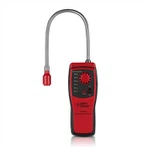
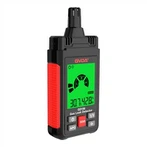
What is the principle of anemometer?
An anemometer is an instrument used to measure wind speed. There are many types. The wind cup anemometer is commonly used in weather stations.
It consists of three parabolic cone-shaped empty cups fixed to each other at 120° on a stand.
The entire sensing part is mounted on a vertical axis of rotation. Under the influence of wind, the wind cup rotates around its axis at a speed proportional to the wind speed.
The basic principle of an anemometer is to place a thin metal wire in a fluid and use an electric current to heat the wire above the temperature of the fluid. Therefore, anemometers are called "hot wires".
When the fluid flows through the wire in the vertical direction, it will take away some of the heat from the wire and reduce the temperature of the wire.
According to the theory of forced convection heat transfer, it can be deduced that there is a relationship between the heat loss Q of the hot wire and the velocity v of the fluid.
A standard hot-wire probe consists of two brackets that are tightened by short thin wires. Metal wire is usually made of platinum, rhodium, tungsten and other metals with high melting points and good ductility.
The commonly used wire diameter is 5μm and the length is 2mm; the small probe diameter is only 1μm and the length is 0.2mm. Depending on the purpose, the hot wire probe can also be made into double wire, triple wire, diagonal, V shape, X Shape etc.
In order to improve the strength, metal films are sometimes used instead of metal wires, and a metal film is usually sprayed on the insulating substrate, which is called a hot film probe.
The hot wire probe must be calibrated before use. Static calibration is performed in a special standard wind tunnel.
The relationship between flow rate and output voltage was measured and plotted as a standard curve.
Dynamic calibration is performed in a known pulsating flow field or added to the anemometer heating loop.
The pulsating electrical signal is used to verify the frequency response of the hot-wire anemometer. If the frequency response is not good, it can be improved by using the corresponding compensation circuit.