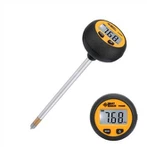
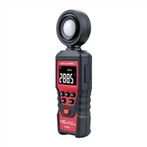
The basic principles and uses of thermal anemometers
Basic principles of thermal anemometer:
1. A thin metal wire is placed in the fluid, and current is passed to heat the wire so that its temperature is higher than the temperature of the fluid, so it is called a wire anemometer. When the fluid flows through the metal wire in the vertical direction, it will take away part of the heat from the metal wire, causing the temperature of the metal wire to drop.
2. According to the forced convection heat exchange theory, it can be derived that there is a relationship between the lost heat Q and the velocity v of the fluid. A standard probe consists of a short, thin wire stretched between two brackets. Metal wire is usually made of metals with high melting points and good ductility such as platinum, rhodium, and tungsten.
3. According to different uses, the head is also made into double wire, triple wire, oblique wire, V shape, X shape, etc. In order to increase the strength, a metal film is sometimes used instead of a metal wire. A thin metal film is usually sprayed on a thermally insulating substrate, which is called a hot film probe. Probes must be calibrated before use.
4. Static calibration is performed in a special standard wind tunnel, and the relationship between flow velocity and output voltage is measured and drawn into a standard curve; dynamic calibration is performed in a known pulsating flow field, or in the anemometer heating circuit. Add a pulsating electrical signal to the frequency response of the calibration line anemometer. If the frequency response is not good, it can be improved with the corresponding compensation circuit.
Thermal anemometer uses:
1. Anemometers are widely used and can be used flexibly in all fields. They are widely used in electric power, steel, petrochemical, energy conservation and other industries. They also have other applications in the Beijing Olympics, sailing competitions, rowing competitions, and outdoor shooting competitions. Anemometers such as anemometers need to be measured using an anemometer.
2. There are many industries that need to use anemometers. Recommended industries include: fishing industry, various fan manufacturing industries, industries that require ventilation and exhaust systems, etc.
3. The working principle of the thermal probe of the anemometer is based on the cold impact airflow taking away the heat on the heating element. With the help of an adjustment switch to keep the temperature constant, the adjustment current is proportional to the flow rate.
4. When using a thermal probe in turbulent flow, airflow from all directions impacts the thermal element at the same time, which will affect the accuracy of the measurement results. When measuring in turbulent flow, the indication value of the thermal anemometer flow sensor is often higher than that of the wheel probe.
The above phenomena can be observed during pipeline measurement. Depending on the design of how pipe turbulence is managed, it can occur even at low speeds. Therefore, the anemometer measurement process should be carried out on the straight part of the pipe.