Structural principle, characteristics and application range of stereo microscope
Stereo microscopes can also be called: solid microscopes or operating and dissecting microscopes. It is a visual instrument with a three-dimensional effect.
The principle of its optical structure is a common primary objective lens. After imaging the object, the two light beams are separated by two sets of intermediate objective lenses, also known as zoom lenses, and form a certain angle called the stereoscopic angle of view. Generally, it is 12 degrees - 15 degrees. After the respective eyepieces are imaged, its magnification change is obtained by changing the distance between the middle mirror groups. Using the dual-channel optical path, the left and right beams in the binocular tube are not parallel, but have a certain angle, which is the left and right beams. The eye provides a three-dimensional image. It is essentially two single-lens tube microscopes placed side by side, and the optical axes of the two tubes form a viewing angle equivalent to that formed when people observe an object with binoculars, thereby forming a three-dimensional stereoscopic image.
Its characteristics are: large diameter of field of view, large depth of focus, so that it is convenient to observe all levels of the object to be detected; although the magnification is not as good as that of conventional microscopes, its working distance is very long; it is like an upright, easy to operate, because it is in the eyepiece The prism below turns the image upside down.
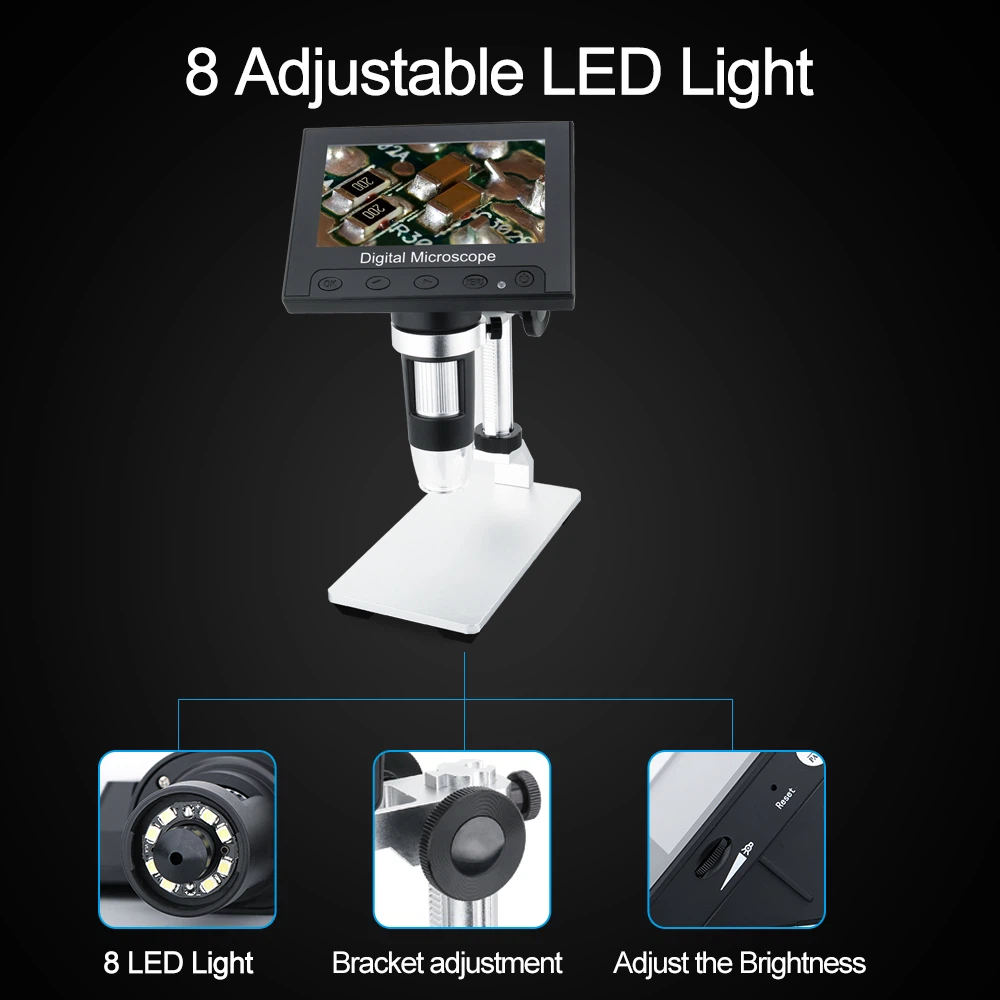
According to the actual use requirements, the current stereo microscope can be equipped with rich accessories. For example, if you want to get a larger magnification, you can choose an eyepiece with a higher magnification and an auxiliary objective lens. , electronic eyepiece and image analysis software form a digital imaging system connected to a computer for analysis and processing. The lighting system also has reflected light and transmitted light lighting. The light sources include halogen lamps, ring lights, fluorescent lamps, and cold light sources.
According to these optical principles and characteristics of the stereo microscope, it is widely used in industrial production and scientific research. For example, it is used for slice operation and microsurgery in the fields of biology and medicine; it is used for observation, assembly and inspection of tiny parts and integrated circuits in industry.