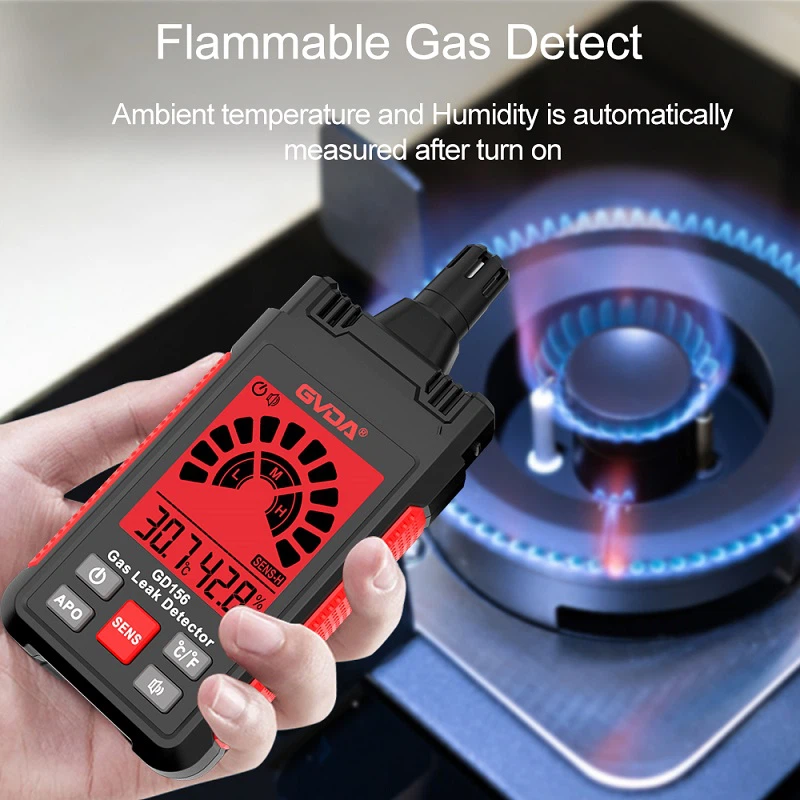
Summary of knowledge about gas detectors
1. Can the fixed combustible gas detector be made into two-wire wiring?
No, the two-wire signal and power supply share one wire, and the maximum working current provided is 20ma, while the working current of the combustible gas sensor is 80ma, which cannot meet its normal working current.
2. How is the effective detection range of a fixed gas detector defined?
According to the "Code for Design of Combustible Gas and Toxic Gas Detection and Alarm in Petrochemical Enterprises" (SH3063-1999):
"3.0.8 The effective coverage horizontal plane radius of the combustible gas detector should be 7.5m indoors and 15m outdoors. One detector can be installed within the effective coverage area. The distance between the toxic gas detector and the release source, It should not be larger than 2m outdoors, and not larger than 1m indoors."
3. What are the regulations on the installation height of the fixed gas detection alarm?
According to the "Code for Design of Combustible Gas and Toxic Gas Detection and Alarm in Petrochemical Enterprises" (SH3063-1999):
"6.1.1 The detectors for detecting combustible gases or toxic gases heavier than air should be installed at a height of 0.3-0.6m from the floor (or floor).
Note: Gas density greater than 0.97kg/m3 (under standard conditions) is considered heavier than air; gas density less than 0.97kg/m3 (under standard conditions) is considered lighter than air.
6.1.2 The detector for detecting flammable gas or toxic gas lighter than air should be installed at a height of 0.5-2m higher than the release source. "
4. What kind of standard gas is used to calibrate the combustible gas detector?
According to the "combustible gas detection and alarm" (JJG693-2004):
"5.1.2.1 Gas standard substance Use the same standard substance as the gas to be measured, and isobutane or propane gas standard substance can be used for general-purpose instruments."
The company uses isobutane for calibration.
5. What is the principle of catalytic combustion detection?
The principle of catalytic combustion is to prepare a high-temperature-resistant catalyst layer on the surface of the platinum resistor. At a certain temperature, the combustible gas is catalytically combusted on its surface. The combustion causes the temperature of the platinum resistor to rise and the resistance to change. The change value is the concentration of the combustible gas. function.
6. What does F.S mean?
F.S is an acronym for full scale. It indicates the size of the measurement range.
7. What kinds of display screens are currently on the market, and what are their characteristics?
Light-emitting diodes (LEDs), liquid crystal displays (LCDs), and organic light-emitting displays (OLEDs) are currently on the market.
8. Which gases can be detected by the gas detector based on the principle of PID photoionization detection?
Photoion gas sensor (PID) is the most convenient and sensitive detection method for detecting volatile organic compounds (VOCs), especially for gas leakage with very low concentration, which has incomparable advantages over other types of sensors. Generally speaking, photoion gas sensor The sensor (PID) is mainly used for the detection of volatile organic compounds (VOCs), which include:
Aromatics: benzene, xylene, naphthalene, etc.;
Saturated and unsaturated hydrocarbons: octane, ethylene, cyclohexane, etc.;
Ketones, aldehydes, ethers: acetone, propionaldehyde, propylmethyl ether, etc.;
Halogenated hydrocarbons, thiohydrocarbons, alcohols, esters, hydrazines, etc.
In addition, detectable inorganic substances include: arsenic, ammonia.
9. What do the letters in the explosion-proof grade ExdⅡCT6 mean?
Ex explosion-proof public mark d Flameproof type (electrical equipment with flameproof enclosure) Class II: Electrical equipment for all other explosive gas atmospheres except coal mines and underground mines. C: Refers to the ignition energy uJ, 280, >180, 60...80, <60. T6: refers to the temperature group, T6 is 85 degrees.
10. What is the role of the pretreatment of the online gas detector?
On-line gas analyzers should be mostly used in sites with complex working conditions. The moisture, dust, and high temperature of the sample gas will have various effects on the detection of the instrument. Through the pretreatment system, the dry, clean and constant sample gas can be sent to the gas analysis instrument after sampling, heat preservation, oil removal, dust removal, condensation and water removal, pressurization or decompression, constant flow and constant pressure. Perform testing to ensure the accuracy and stability of the measured values.
11. What kinds of principles can the online oxygen detector be used for detection?
Zirconia, electrochemical, paramagnetic, laser
12. Why do you have to fill in the background gas composition in the industrial and mining questionnaire in detail?
On-line gas detectors should be mostly used in sites with complex working conditions. Different gases may cause cross-interference or even corrosion. By filling in the background gas in detail, factors such as instrument selection, interference, and corrosion can be fully considered in the analyzer design stage. To ensure the stability and safety of the instrument after it is put into use.
13. What role does the vortex condenser play in pretreatment?
Reduce the moisture content in the sample gas
14. Under what circumstances do you need to use a pressure reducing valve in the pretreatment of the online gas detector? Under what circumstances do you need to use an aspirator?
When the sample gas pressure in the pipeline is >0.2MPa, a pressure reducing valve should be used. When the pressure is less than 50KPa, a suction pump should be used.
15. What are the steps of dust removal in the pretreatment of online gas detector?
Generally, there are three stages of filtration: sampling probe filter, filter in pretreatment, and fine filter in analysis instrument. The specific configuration depends on the actual conditions of the working conditions.
16. What value is the oxygen deficiency alarm point generally set for the oxygen gas detection alarm instrument?
18.5%VOL
17. If the pipeline of the analytical instrument is in a state of vibration, which detection principle cannot be used?
Laser principle and paramagnetic principle