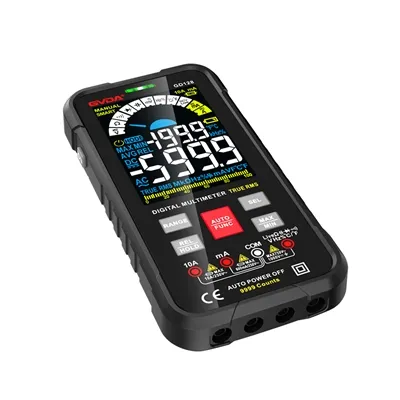
Talking about the use method and precautions of multimeter
Multimeters are also called multimeters, multimeters, and multimeters. They refer to instruments that can be used to measure AC and DC voltages, resistances, DC currents, and audio levels. Advanced multimeters can also be used to measure AC current, capacitance, inductance and some parameters of semiconductors (such as β). All in all, it's a must-have tool for electricians and radio production. After collecting and sorting out the information, the editor will introduce the use method and precautions of the multimeter (digital multimeter use) for you in detail.
Generally, we should understand the following aspects before using a multimeter (AC millivoltmeter):
(1) Be familiar with the meanings of the symbols on the dial and the main functions of each knob and selector switch.
(2) Carry out mechanical zero adjustment. That is, when there is no electricity to be measured, make the pointer of the multimeter point to the position of zero voltage or zero current.
(3) According to the type and size of the measured object, select the position and range of the transfer switch, and find out the corresponding scale line.
For voltage measurement, align the tip of the range selection switch with the five-speed range marked with V. If the AC voltage is measured, it should point to V. By analogy, if the resistance is to be changed, the switch should point to the Ω file range. The measured current should point to mA or UA.
(4) Select the position of the test lead jack.
(5) How to understand the reading of the multimeter
According to the approximate value of the circuit under test, select an appropriate range position. Note that the value indexed by the tip of the range switch is the corresponding value of the full-scale reading of the needle on the meter head. When reading the meter, you only need to convert it accordingly to read the real value.
For example, the maximum value of each dry battery is 1.5V, so it can be placed in the 5V range. At this time, the 500 of the full scale reading of the hands on the panel should be read as 5. i.e. scaled down by a factor of 100. If the needle is at the 300 mark, it reads 3V. Except for the resistance range, all range switch ranges can read the measurement results in this way.
How to use the multimeter
1. Measuring voltage: Choose a good range when measuring voltage (or current). If you use a small range to measure a large voltage, there will be a danger of burning the meter; if you use a large range to measure a small voltage, the pointer deflection is too small to be able to reading. The selection of the range should try to make the pointer deflect to about 2/3 of the full scale. In the actual measurement, when the approximate value of the measured voltage cannot be determined, the switch can be turned to the maximum range first, and then the range can be reduced step by step to a suitable position. Generally, when measuring voltage, the ammeter pen should be connected to the circuit under test.
a. Measurement of AC voltage: Set one switch of the multimeter to the AC and DC voltage range, and the other switch to the appropriate range of AC voltage, and connect the two pens of the multimeter to the circuit or load under test in parallel.
b Measurement of DC voltage: Put one switch of the multimeter on the AC and DC voltage range, and the other switch on the appropriate range of DC voltage, and connect the "+" test lead (red test lead) to the high potential, "- "The test lead (black test lead) is connected to the low potential, that is, let the current flow in from the "+" test lead and flow out from the "-" test lead. If the test leads are reversed, the pointer on the meter head will deflect in the opposite direction, and it is easy to bend the pointer.
2. Current measurement: When measuring DC voltage, set one switch of the multimeter to the DC current range, and the other switch to the appropriate range from 50uA to 500mA. The range selection and reading method for current is the same as for voltage. At this time, attention should be paid to the positive and negative polarities. If the test leads are connected reversely, the hands of the test will reverse. If you don't know the positive and negative polarity of the circuit, you can put the range of Wantian meter at the maximum range, try it quickly on the circuit under test, and see how the pen needle deflects, you can judge the positive and negative polarity. There is no positive or negative. When measuring, the circuit must be disconnected first, and then the multimeter is connected in series to the circuit under test according to the direction of the current from "+" to "-", that is, the current flows in from the red test lead and flows out from the black test lead.
When measuring DC current, if the multimeter is mistakenly connected in parallel with the load, the internal resistance of the meter head is very small, which will cause a short circuit and burn the meter. The reading method is as follows: actual value = indicated value × range / full deviation
3. Measuring resistance: When measuring resistance with a multimeter, the following methods should be followed:
a Mechanical zero adjustment. Before use, you should adjust the pointer positioning screw to make the current indication zero to avoid unnecessary errors.
b Select the appropriate magnification file. The scale line of the ohm scale of the multimeter is uneven, so the selection of the magnification scale should make the pointer stay on the thinner part of the scale line, and the closer the pointer is to the middle of the scale, the more accurate the reading will be. In general, the pointer should be between 1/3~2/3 of the scale.
c ohms to zero. Before measuring the resistance, the two test leads should be short-circuited, and the "ohm (electrical) zero adjustment knob" should be adjusted at the same time so that the pointer just points to the zero position on the right side of the ohm scale. If the pointer cannot be adjusted to the zero position, it means that the battery voltage is insufficient or there is a problem inside the meter. And every time the magnification gear is changed, the ohm zero adjustment must be performed again to ensure accurate measurement.
d Reading: Multiply the reading of the meter head by the magnification, which is the resistance value of the measured resistance.
At first glance, the multimeter looks very complicated, but in fact it is composed of an ammeter (commonly known as the meter head), a dial, a range selection switch, and test leads. When in use, if the range selection switch is pointed to the DC current range, the ammeter M is connected with some shunt resistors in parallel to realize the purpose of expanding the range, making it an ammeter with several different ranges. The measurement result depends on the reading of the DC current scale on the dial. Usually the second line on the dial is the current scale. Similarly, if the range selection switch points to the DC voltage range, the meter head is connected in series with other resistors (using the principle of series resistor voltage division to make it a multi-range voltmeter). The reading depends on the DC voltage scale on the dial. Most multimeters use a single scale for voltage and current. If a rectifier is connected to the circuit for measuring DC voltage, AC voltage can be measured. The principle of measuring resistance is similar to that of measuring DC voltage, except that a set of batteries must be added during the test. When the selection switch is pointing to the resistance range, just find the first row of resistance-specific scale readings on the dial.
Precautions for using the multimeter
There are many models of multimeters, but the basic usage methods are the same. Now take the MF30 multimeter as an example to introduce its usage.
Preparations before use First, before using the multimeter, you must be familiar with the function of the range selection switch. What exactly do you want to measure? How to measure? Then turn the range selection switch to the position where the test gear is required. Never get the gear wrong. For example: When measuring the voltage, when the selector switch is mistakenly set to the current or resistance position, it is easy to burn out the meter head.
Second, check whether the hands of the watch are at zero before use. If the zero position is not indicated, use a screwdriver to adjust the mechanical zero adjustment screw on the meter head to make the hands return to zero (generally, it is not necessary to adjust every time). The red test lead should be inserted into the positive socket, and the black test lead should be inserted into the negative socket.
Precautions for using the multimeter
Precautions for using the multimeter
(1) In the process of using the multimeter, do not touch the metal part of the test lead with your hands, so that on the one hand, the accuracy of the measurement can be guaranteed, and on the other hand, personal safety can also be guaranteed.
(2) When using the multimeter, it must be placed horizontally to avoid errors. At the same time, attention should be paid to avoid the influence of the external magnetic field on the multimeter.
(3) When measuring a certain amount of electricity, it is not possible to change gears while measuring, especially when measuring high voltage or high current, more attention should be paid. Otherwise, the multimeter will be damaged. If you need to shift gears, you should disconnect the test leads first, and then measure after shifting gears.
(4) After using the multimeter, the transfer switch should be placed at the maximum level of the AC voltage. If it is not used for a long time, the battery inside the multimeter should also be taken out to prevent the battery from corroding other components in the meter.