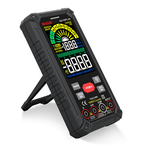
Technical conditions of illuminance meter instrument
Do you often use your intuition to judge the brightness of a light source? Or use the same method to determine which of similar products is brighter? Do you know how big the difference can be? I think everyone must be very concerned about whether the light distribution of a lamp is consistent with the original design. As a pioneer in the lighting industry, you and I should really make good use of this lighting tool - the illuminance meter. Faced with many different brands of illuminance meters, the gap between their quality and price is also very wide. How to make the appropriate choice is often nerve-wracking. Here is a simple explanation:
An ideal illuminance meter should have the following conditions:
● Compact Size, Light Weight
The illuminance meter has a wide range of uses, and the timing of use is often in different places. Therefore, the portable size, small size and light weight are the prerequisites for the illuminance meter.
● Accuracy?Accuracy?
Whether a light meter is good or bad has a direct relationship with its accuracy. Of course, it is also closely related to its price. Therefore, it is necessary to buy a high-accuracy illuminance meter at a reasonable price. Generally, it is appropriate to have an error of no more than ±15%.
● Color Compensation ?Color Compensation?
The types of light sources are all-encompassing. Some focus on red high-pressure lamps with longer wavelengths, or blue-violet lamps with shorter wavelengths such as Daylight fluorescent lamps. There are also evenly distributed ones such as incandescent light bulbs. The same illuminance meter may have slightly different sensitivity to different wavelengths. are different, so appropriate compensation is necessary.
●Cosine Compensation?Cosine Compensation?
As we all know, the brightness of the illuminated surface is related to the incident angle of the light source. In the same way, when measuring with a light meter, the incident angle of the sensor and the light source will naturally affect the reading of the light meter. Therefore, whether a good illuminance meter has the function of cosine compensation cannot be ignored.