Telescope vs Handheld Laser Rangefinders: Key Differences
Laser ranging is measured using a laser as the light source. According to the working mode of lasers, they can be divided into continuous lasers and pulsed lasers. Gas lasers such as helium neon, argon ion, and krypton cadmium operate in a continuous output state for phase based laser ranging; Dual heterojunction gallium arsenide semiconductor laser, which can be used for infrared ranging; Solid state lasers such as ruby and neodymium glass can be used for pulsed laser ranging.
Due to the good monochromaticity and strong directionality of lasers, coupled with the semiconductor integration of electronic circuits, laser rangefinders can not only work day and night, but also improve ranging accuracy, significantly reduce weight and power consumption, and make measuring distances to distant targets such as artificial Earth satellites and the moon a reality compared to optoelectronic rangefinders. If the laser is continuously emitted, the measuring range can reach about 40 kilometers and it can operate day and night. If the laser is pulsed, the absolute accuracy is generally low, but when used for long-distance measurements, it can achieve good relative accuracy.
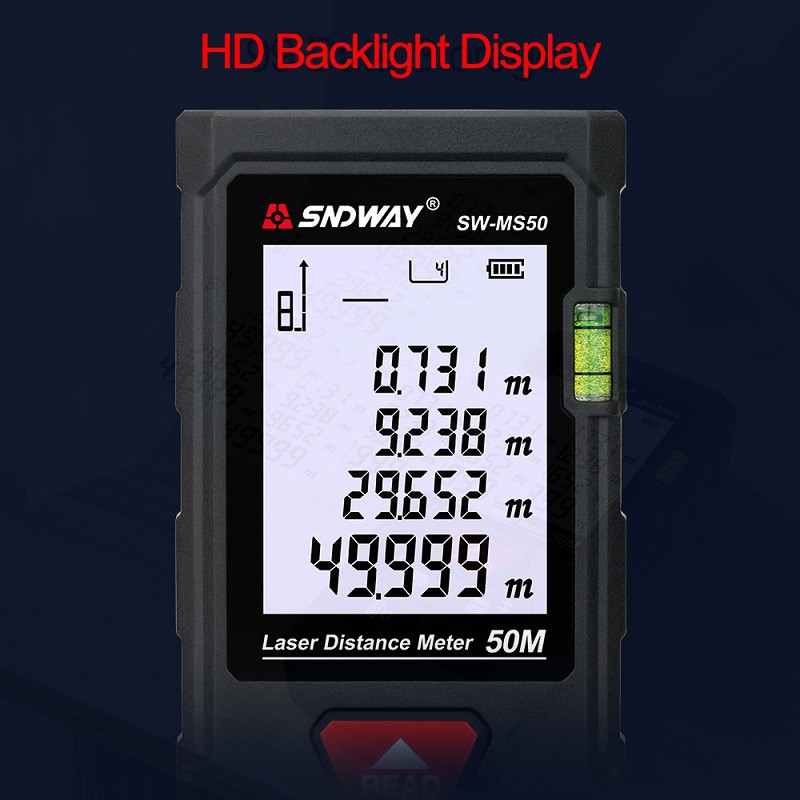
Handheld laser rangefinder
The measurement distance is generally within 200 meters, with an accuracy of about 2mm. This is currently the most widely used laser rangefinder. In terms of functionality, in addition to measuring distance, it can generally also calculate the volume of the measured object.
Telescope type laser rangefinder
The measurement distance is generally around 600-3000 meters. This type of rangefinder measures a relatively long distance, but the accuracy is relatively low, usually around 1 meter. The main application scope is long-distance field measurement.
Industrial laser rangefinder
The measurement distance is around 0.5-3000 meters, with an accuracy within 50mm. A reflector should be added 300 meters away, and some products can also measure speed while measuring distance. Mainly used for position control, such as vehicles and ships; Positioning crane; Loading, unloading, and handling equipment; Aircraft measurement, mainly for measuring flight altitude; Metallurgical process control; Measure objects that should not be approached, such as pipe fillers, pipelines, containers, etc., as well as water level measurements. Typical sensors include LDM301 and LDM4x.