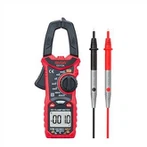
Testing Methods and Practical Experience for Measuring Resistors with a Multimeter:
Fixed resistor testing. A?Connect both probes (without distinguishing between positive and negative) to the two ends of the resistor to measure the actual resistance value. To improve measurement accuracy, select the range based on the nominal value of the resistor being tested. Due to the non-linear relationship of the ohms scale, the middle section of the scale is finer, so the pointer indication should be made to fall as much as possible in the middle section of the scale, within the range of 20% to 80% of the full scale, to ensure more accurate measurement. Depending on the level of resistance error, the reading may deviate from the nominal resistance value by ±5%, ±10%, or ±20%. If there is a discrepancy and the deviation exceeds the error range, it indicates that the resistance value has changed. B?Note: When testing, especially when measuring resistors with values above tens of kΩ, avoid touching the probes and conductive parts of the resistor with your hands; the resistor being tested should be soldered off from the circuit, with at least one end disconnected, to prevent other components in the circuit from affecting the test and causing measurement errors; although the resistance value of a color-coded resistor can be determined by the color code, it is best to use a multimeter to test its actual resistance value when in use.
The detection of cement resistors. The methods and precautions for detecting cement resistors are exactly the same as those for detecting ordinary fixed resistors.