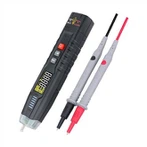
The basic operation method for measuring resistance with a multimeter:
1. Firstly, connect the probe. The selection of a multimeter can be either a pointer or a digital display. Insert the red probe into the V Ω range and the black probe into the COM terminal to ensure that the multimeter is functioning properly.
2. Rotate the multimeter gear to measure resistance using the resistance gear. If you are unsure of the resistance value, you should first set the range switch to the maximum value, and then switch from a large range to a small range, so that the instrument pointer indicates more than half of the full scale. After selecting the appropriate magnification range, touch the two probes to make the pointer point at the zero position. If the pointer deviates from the zero position, adjust the "zero adjustment" knob to reset the pointer to zero to ensure accurate measurement results.
3. Connect the two segments of the resistor and connect the probes randomly, without any distinction between positive and negative. It is important to ensure good contact.
4. Read the data displayed on the multimeter. If there is no data on the multimeter, it is possible that the resistor is damaged. Of course, there is also a possibility that the range is not enough and the range should be replaced.
5. Increase the range. If there is no data left, it can only indicate that the resistor is faulty. If there is data output, pay attention to adding gear units.
The basic principle of a multimeter:
It uses a sensitive magnetoelectric DC ammeter (microampere meter) as the meter head. When a small current passes through the meter head, there will be a current indication. But the meter head cannot pass through large currents, so it is necessary to shunt or reduce voltage by connecting some resistors in parallel or series on the meter head, in order to measure the current, voltage, and resistance in the circuit.
Precautions for using a multimeter:
1. Before using a multimeter, it is necessary to perform a "mechanical zero adjustment", which means that when there is no measured electricity, the multimeter pointer should be positioned at zero voltage or zero current.
2. During the use of a multimeter, do not touch the metal part of the probe with your hands. This ensures accurate measurement and personal safety.
3. When measuring a certain amount of electricity, it is not advisable to shift gears simultaneously, especially when measuring high voltage or high current. Otherwise, it may cause damage to the multimeter. If you need to shift gears, you should first disconnect the probe and then take measurements after shifting gears.
4. When using a multimeter, it must be placed horizontally to avoid errors. At the same time, attention should also be paid to avoiding the influence of external magnetic fields on the multimeter.
5. After using the multimeter, the transfer switch should be set to the maximum AC voltage. If not in use for a long time, the battery inside the multimeter should also be removed to prevent the battery from corroding other components inside the meter.