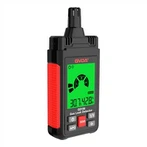
The difference between a clamp-on ground resistance tester and a multimeter is as follows
To ensure accurate and safe measurement, the grounding resistance clamp meter should be checked before use.
1. Appearance inspection: There should be no defects such as damage. Special attention should be paid to ensure that the jaws are tightly closed. The iron core should be free of rust and dirt.
If it is a mechanical pointer type ground resistance clamp meter, the pointer should point to "0" at this time. Otherwise, it should be adjusted to the "0" position.
3. Estimate the magnitude of the measured current and select the appropriate gear. The principle of gear selection is to adjust it to be greater than the measured value. And it's also close to the gear.
Open the jaws during measurement. Insert the measured wire into the clamp, close the clamp, and deflect the needle. The measured current value can be read out. Before reading, the ground resistance clamp meter should be placed as flat as possible (mechanical pointer ground resistance clamp meter). The digital grounding resistance clamp meter doesn't matter.
Attention should be paid during measurement
1. Gloves should be worn during testing (insulated gloves should be clean and dry wire gloves). If necessary, a guardian should be appointed.
When shifting gears for measurement, the wire should be pulled out of the clamp first. After shifting gears, clamp in the wire for measurement.
3. Voltage of the tested wire. Cannot exceed the voltage level of the grounding resistance clamp meter.
4. Poor insulation and the use of grounding resistance clamp meters for measuring wires are prohibited.
5. When measuring, pay attention to maintaining a safe distance from nearby charged objects. And care should be taken not to cause phase to phase short circuits and relative to ground short circuits.
6. It is not advisable to measure line current in high temperature environments. It is not suitable to measure near strong magnetic fields, as external magnetic fields have a significant impact on measurement values. Grounding resistance clamp meters should not be used for measurement near busbars, large capacity motors, transformers, and other high load current equipment. It should be measured in a different location to reduce error short circuits caused by magnetic fields.
7. It is not suitable to measure in damp places and thunderstorm weather, as the grounding resistance clamp meter must be held in hand for direct measurement of electrical equipment in operation. The jaws, handle, and hands of the grounding resistance clamp meter must be kept clean and dry during measurement.
8. The grounding resistance clamp meter has a large error in measuring non rated current. The working principle of the grounding resistance clamp meter determines that it should be used at a specified rate. In addition to measuring sine wave current, the measurement of other waveform currents will also produce errors. Generally, the waveform error of odd harmonics is larger than that of even spectral waves. Especially when the third harmonic error increases, measuring the half wave rectified current with a ground resistance clamp meter also results in significant errors.
After use, the gear should be set to high current mode, and if there is a meter cover, it should be placed in the meter cover. Store in a dry, dust-free, non corrosive gas free, and vibration free place.
10. High voltage current cannot be measured, and the voltage of the tested circuit must not exceed the rated voltage of the grounding resistance clamp meter. The grounding resistance clamp meter cannot measure high-voltage electrical equipment.