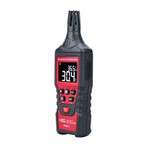
The difference between analogue and digital multimeters
Analog Multimeter: Both analog and digital multimeters have their own advantages and disadvantages. The analog multimeter is an average meter with an intuitive and vivid reading indication. (Generally, the reading value is closely related to the pointer swing angle, so it is very intuitive). A digital multimeter is an instantaneous instrument. It takes a sample every 0.3 seconds to display the measurement results. Sometimes the results of each sampling are only very similar, not exactly the same, which is not as convenient as the pointer type for reading the results. Pointer multimeters generally do not have an amplifier inside, so the internal resistance is small, and the DC voltage sensitivity is 100 kΩ/V. DC voltage sensitivity is 20 kΩ/V. Because the digital multimeter uses an operational amplifier circuit inside, the internal resistance can be made very large, often 1M ohm or more. (That is, higher sensitivity can be obtained).
This makes the impact on the circuit under test smaller and the measurement accuracy higher. Because the internal resistance of the pointer multimeter is small, discrete components are often used to form a shunt and voltage divider circuit. Therefore, the frequency characteristics are uneven (compared to digital ones), while the frequency characteristics of analog multimeters are relatively better. The internal structure of the analog multimeter is simple, so it has lower cost, fewer functions, simple maintenance, and strong overcurrent and overvoltage capabilities. The digital multimeter uses a variety of oscillation, amplification, frequency division protection and other circuits internally, so it has many functions. For example, it can measure temperature, frequency (in a lower range), capacitance, inductance, make a signal generator, etc. Digital multimeters have poor overload capabilities due to their internal structure using integrated circuits. (However, some now have automatic gear shifting, automatic protection, etc., but they are more complicated to use.) They are generally not easy to repair after damage. Digital multimeters have low output voltages (usually no more than 1 volt). It is inconvenient to test some components with special voltage characteristics (such as thyristors, light-emitting diodes, etc.). Pointer multimeters have higher output voltages (10.5 volts, 12 volts, etc.). The current is also large (for example, the MF-500*1 ohm range has a maximum of about 100 mA), which can easily test thyristors, light-emitting diodes, etc. Beginners should use an analog multimeter, and non-beginners should use both instruments.
The measurement circuit is a circuit used to convert various measured objects into tiny DC currents suitable for meter measurement. It is composed of resistors, semiconductor components and batteries.
It can transform various measured objects (such as current, voltage, resistance, etc.) and different ranges into a certain amount of tiny DC current after a series of processing (such as rectification, shunting, voltage division, etc.). The meter head is used for measurement.
transfer switch
Its function is to select various measurement lines to meet the measurement requirements of different types and different ranges. There are generally two transfer switches, each marked with different gears and ranges.