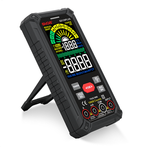
The difference between testing with a multimeter and using an oscilloscope
Multimeters and oscilloscopes are all too familiar to electronics engineers. It can be said to be an indispensable tool for R&D, debugging and maintenance. Of course, the functions of a multimeter and an oscilloscope are completely different.
There are two types of multimeters: pointer type and digital type; the pointer type has basically been eliminated, and digital multimeters are basically used now.
Multimeters can be used to measure resistance, AC and DC voltages, AC and DC currents, diodes, capacitance, frequency, etc. Multimeters are simple and easy to use. Just turn the gear to the function gear you need to measure and you can measure.
Special attention needs to be paid when using a multimeter to measure current. To measure current, the multimeter needs to be connected in series to the circuit, and the red test lead needs to be inserted into a jack suitable for the range. If the current exceeds the range, the multimeter's fuse will be burned out.
Oscilloscope
There is a difference between an oscilloscope and a multimeter. A multimeter can only display the measured value. An oscilloscope can quickly and continuously measure a signal and plot it into a curve, which is displayed on the screen.
Oscilloscopes are used in a wide range of applications. It can convert signals invisible to the naked eye into images. We can analyze changes in various signals and data based on the measured signal waveforms.
The oscilloscope has many functions and menus, and you need certain basic knowledge to use it.
Multimeters are divided into 2 types: analog and digital.
The pointer of the analog meter swings flexibly, making it easier to judge changes in the circuit.
The multimeter intelligently measures DC signals and low-frequency pure AC signals more accurately. Most AC signals and digital signals can only be detected with an oscilloscope. Because the oscilloscope can display various detected signal waveforms in the electronic circuit on the oscilloscope tube, it allows people to accurately judge whether the circuit is normal during equipment maintenance and circuit debugging.
Electrical signals in circuits, especially weak-current electronic circuits, may be complex, random, and transient. In this case, an oscilloscope can be used to analyze the signal characteristics and estimate its electrical parameters. Multimeters can only measure typical electrical parameters of steady-state electrical signals, and are inconvenient for measurement and analysis of complex electrical signal parameters. The multimeter is suitable for measuring traditional strong current lines, and can also measure certain parameters in weak current lines. Oscilloscopes are widely used in electronic circuits and are less suitable for strong current circuits.
It goes without saying that the various functions of a multimeter are known to everyone. However, when measuring a signal, the multimeter can only measure a rough voltage to initially judge and guess whether there is a fault at the measurement point. It cannot be accurately judged, but an oscilloscope can intuitively see it. Whether the waveform at the measurement point is deformed or the signal is lost can accurately determine whether there is a fault or distortion. For example, the line-field scanning waveform of a tube TV, whether the waveform of the TV signal in each signal amplification circuit is distorted or lost, can be Visually see if there are any problems