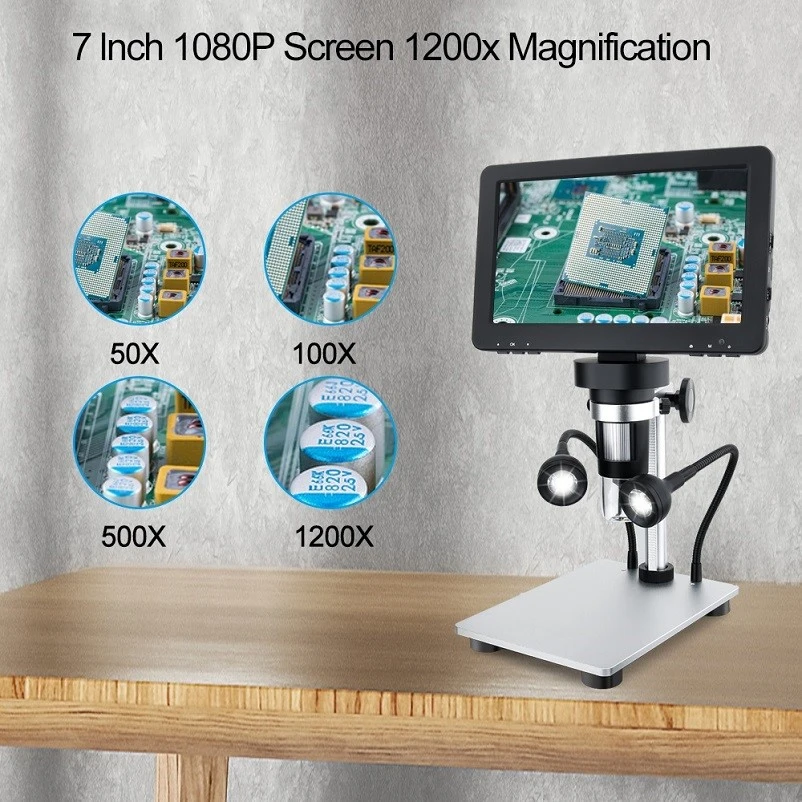
The key points of knowledge about ultra-depth-of-field microscopy can be learned in one go
Since the working distance of the three-dimensional super depth-of-field microscope is very small, everyone must be careful when using the oil lens to prevent damage to the lens on the objective lens and the sample glass during operation.
The process of use usually follows the process of starting from a low-power lens, then to a high-power lens, and then to an oil lens. If you are using a high-power lens, there is no need to convert it to a low-power lens and start over. You can just convert it directly to an oil lens.
If the microscope you are using has an anti-drop function, when using it, add a drop of cedar oil to the slide under observation, move the oil microscope down into the oil drop until it stops falling, and then Use fine-tuning to make subtle adjustments until a clear object image is obtained; and if the microscope used does not have an automatic stop function, then after adding drops of cedar oil on the slide, when moving the objective lens down, you should look at it from the side and lower the objective lens. Move it until it is slightly in contact with the slide, and then fine-tune it upward until the focus is correct.
Working principle of three-dimensional ultra-depth-of-field microscope:
1. Refraction and refractive index:
Light propagates in a straight line between two points in a uniform isotropic medium. When passing through transparent objects with different density media, refraction occurs. This is due to the different propagation speeds of light in different media. When light rays that are not perpendicular to the surface of a transparent object are incident on a transparent object (such as glass) from the air, the light ray changes direction at its interface and forms a refraction angle with the normal.
2. Lens performance:
Lens is the basic optical element that makes up the optical system of a three-dimensional super depth-of-field microscope. The objective lens, eyepiece, condenser and other components are composed of single or multiple lenses. According to their different shapes, they can be divided into two categories: convex lenses (positive lenses) and concave lenses (negative lenses).
When a beam of light rays parallel to the optical axis passes through a convex lens and intersects at a point, this point is called the "focus", and the plane that passes through the intersection point and is perpendicular to the optical axis is called the "focal plane". There are two focal points. The focus in the object-space space is called the "object-space focus", and the focal plane there is called the "object-space focal plane". On the contrary, the focus in the image-space space is called the "image-space focus". The focal plane at is called the "image square focal plane".
After light passes through a concave lens, it forms an upright virtual image, while a convex lens forms an upright real image. Real images can appear on the screen, but virtual images cannot.