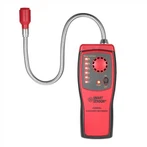
The main considerations when choosing an infrared thermometer are as follows:
In terms of performance indicators, such as:
Temperature measurement range: Each model of thermometer has its own specific temperature measurement range, which should not be too narrow or too wide. Generally speaking, the narrower the temperature measurement range, the higher the resolution of the output signal for monitoring temperature, and the accuracy and reliability are easy to solve. The temperature measurement range is too wide, which will reduce the temperature measurement accuracy
Working wavelength: According to the blackbody radiation law, the change in radiation energy caused by temperature in the short wavelength of the spectrum will exceed the change in radiation energy caused by emissivity error. Therefore, when measuring temperature, it is advisable to choose short wavelength as much as possible, but emissivity factors must also be considered in conjunction with the detected object.
Spot size: The area of the measuring point of the thermometer is called the "spot size". In order to obtain a temperature reading, the distance between the thermometer and the test target must have an appropriate range. The farther away from the target, the larger the spot size. Therefore, in applications, attention should be paid to the ratio of distance to spot size, also known as D: S. When determining the measurement distance, attention should be paid to ensuring that the target diameter is equal to or greater than the size of the measured light point. If the target is smaller than the size of the measured light point, the thermometer will simultaneously measure the temperature of the background object, thereby reducing the accuracy of the reading.
The distance coefficient (optical resolution) is determined by the ratio of D: S, which is the ratio of the distance D between the thermometer probe and the target to the diameter of the light spot. If the thermometer must be installed far away from the target due to environmental limitations and needs to measure small targets, a high optical resolution thermometer should be selected. The higher the optical resolution, the greater the D: S ratio. If the thermometer is far away from the target and the target is small, a thermometer with a high distance coefficient should be selected. For a fixed focal length thermometer, the spot at the focal point of the optical system is small, and the spot near and far from the focal point will increase. There are two distance coefficients. Therefore, in order to accurately measure temperature at distances close to and far from the focal point, the size of the measured target should be greater than the size of the spot at the focal point. The zoom thermometer has a small focal point position that can be adjusted based on the distance to the target. Increasing D: S reduces the received energy. Without increasing the receiving aperture, it is difficult to increase the distance coefficient D: S.
Response time: Refers to the reaction speed of the infrared thermometer to changes in the measured temperature, defined as the time required to reach 95% of the reading energy after reaching it. It is related to the time constant of the photodetector, signal processing circuit, and display system. If the target's movement speed is very fast or when measuring rapidly heated targets, a fast response infrared thermometer should be selected, otherwise it cannot achieve sufficient signal response and will reduce measurement accuracy. For stationary or target thermal processes with thermal inertia, the response time of the thermometer can be relaxed. Therefore, the selection of response time for infrared thermometers should be adapted to the situation of the measured target, mainly based on the target's movement speed and temperature change speed. For stationary targets or targets involved in thermal inertia, or when the speed of existing control equipment is limited, the response time of the thermometer can be relaxed.