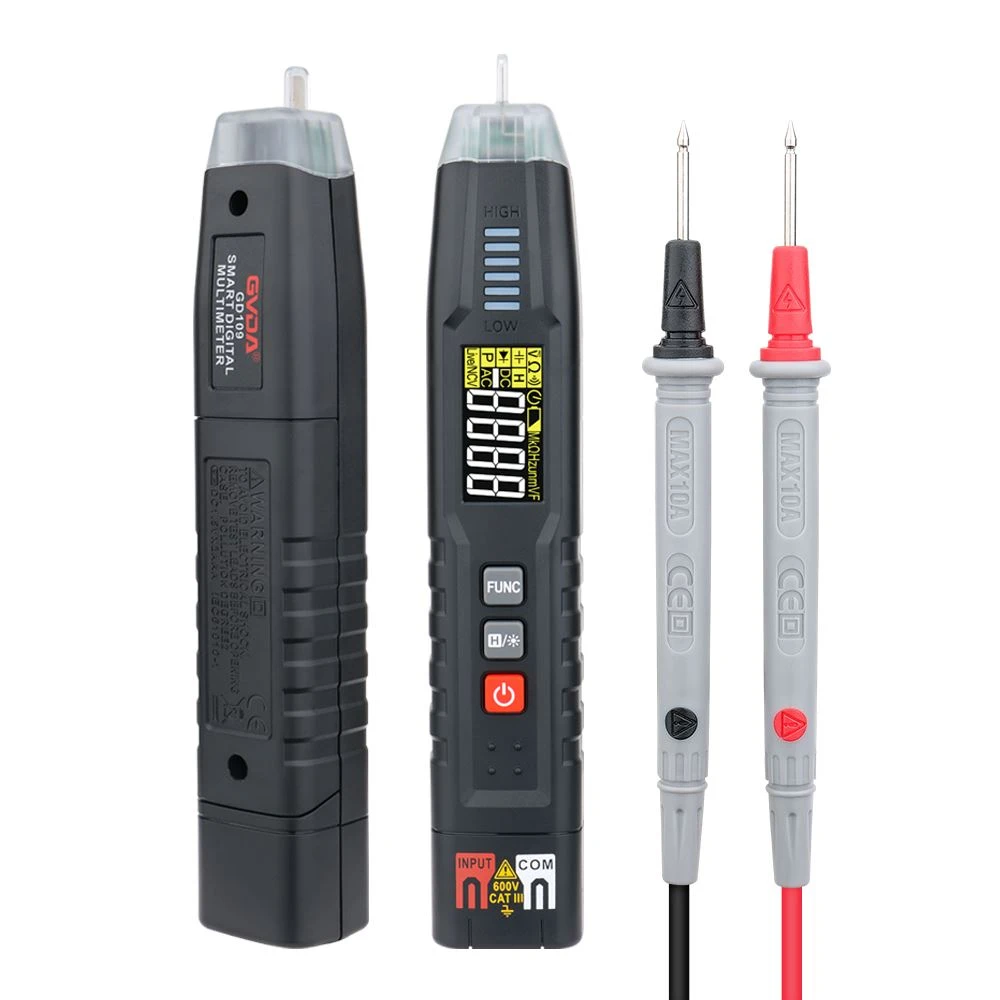
the measurement error of the multimeter's resistance gear
When using the same multimeter to measure the same resistance, what is the error when selecting different ranges?
Taking an MF-30 multimeter as an example, the central resistance of the Rxl0 block is 250Ω, the central resistance of the R×l00 block is 2.5kΩ, and the accuracy level is 2.5. To test whether it is a 500Ω standard resistance, use R×l0 It is measured by the block and the R×100 block, which has the largest error.
1. The maximum absolute allowable error of R×l0 block △R(10)=center resistance×R%=250Ω×(±2.5)%=±6.25Ω.
When measuring 500Ω standard resistance, the indication value of 500Ω standard resistance is between 493.75Ω~506.25Ω.
The maximum relative error is: ±6.25÷500Ω×100%=±1.25%.
2. The maximum absolute allowable error of R×l00 block △R(100)=center resistance×R%2.5kΩ×(±2.5)%=±62.5Ω.
When measuring 500Ω standard resistance, the indication value of 500Ω standard resistance is between 437.5Ω~562.5Ω.
The maximum relative error is: ±62.5÷500Ω×100%=±10.5%.
Summarize:
Different resistance ranges are selected, and the errors generated by the measurement are quite different. When selecting the gear range, try to make the measured resistance value in the center of the arc length of the range scale to improve the measurement accuracy.
The above are the range selection skills of the multimeter's electrical resistance and the calculation formula of the measurement error of the multimeter's electrical resistance. I hope it will be helpful to everyone.