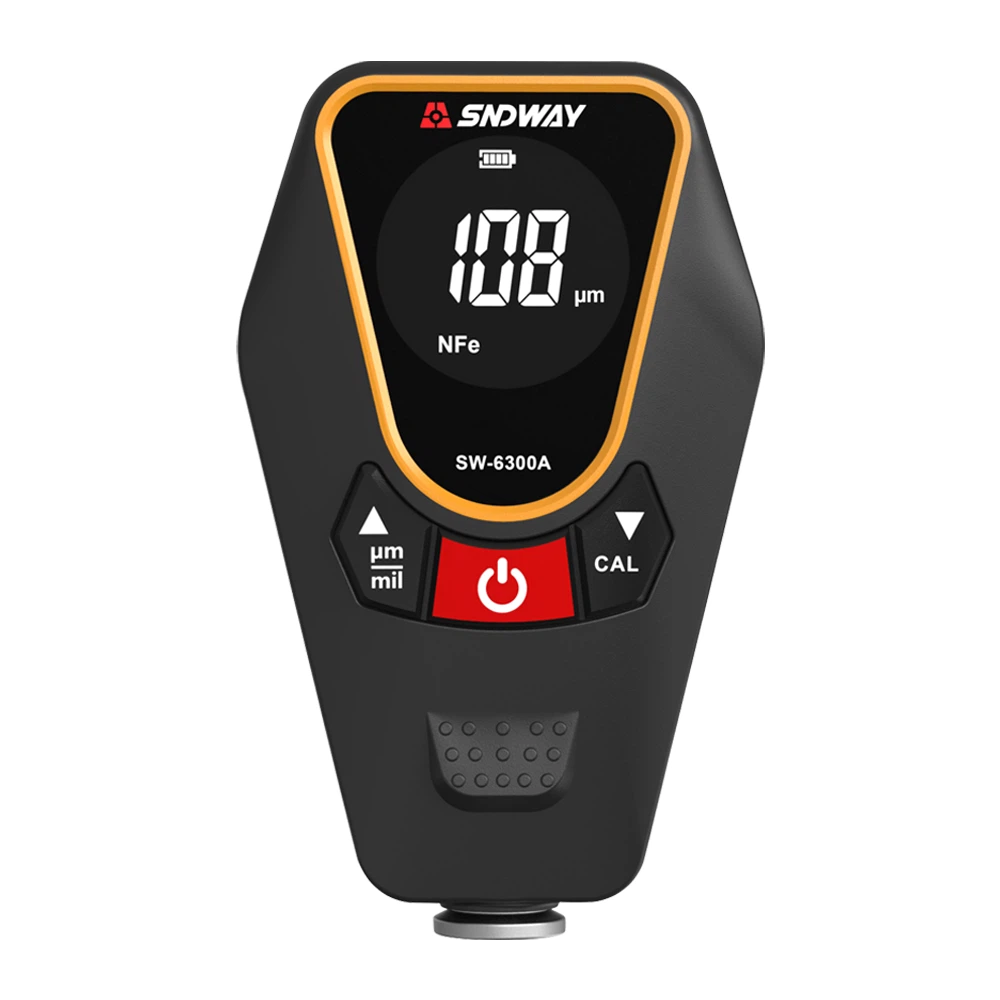
The measurement of coating thickness gauge is imprecise for a number of reasons.
(1) Interference of strong magnetic field. We have done a simple experiment, when the instrument works near the electromagnetic field of about 10,000 V, the measurement will be seriously disturbed. If it is very close to the electromagnetic field, there may be a crash phenomenon.
(2) Human elements. The situation frequently occurs to new users. The coating thickness gauge's ability to transform a slight change in magnetic flux into a digital signal allows it to measure coating thickness down to the micron level. The probe may stray from the body being tested during the measuring procedure if the user is unfamiliar with the instrument. This will modify the magnetic flux and result in an incorrect measurement. Therefore, when using the instrument for the first time, it is advised that users and friends first grasp the measurement procedure.The placement of the probe has a great influence on the measurement. During the measurement, the probe should be kept perpendicular to the surface of the sample. And the probe should not be placed for too long, so as not to cause the interference of the magnetic field of the matrix itself.
(3) During system calibration, the wrong substrate was not chosen. The substrate must have a minimum thickness of 0.2mm and a minimum plane of 7mm. Measurements below this threshold are not accurate.
(4) The impact of any compounds that are linked. The device is sensitive to chemicals that adhere and prevent the probe from getting close to the overlay surface. To guarantee that the probe is in direct touch with the surface of the covering layer, the attached materials must be taken out. Additionally, the surface of the chosen substrate must be bare and smooth for performing system calibration.