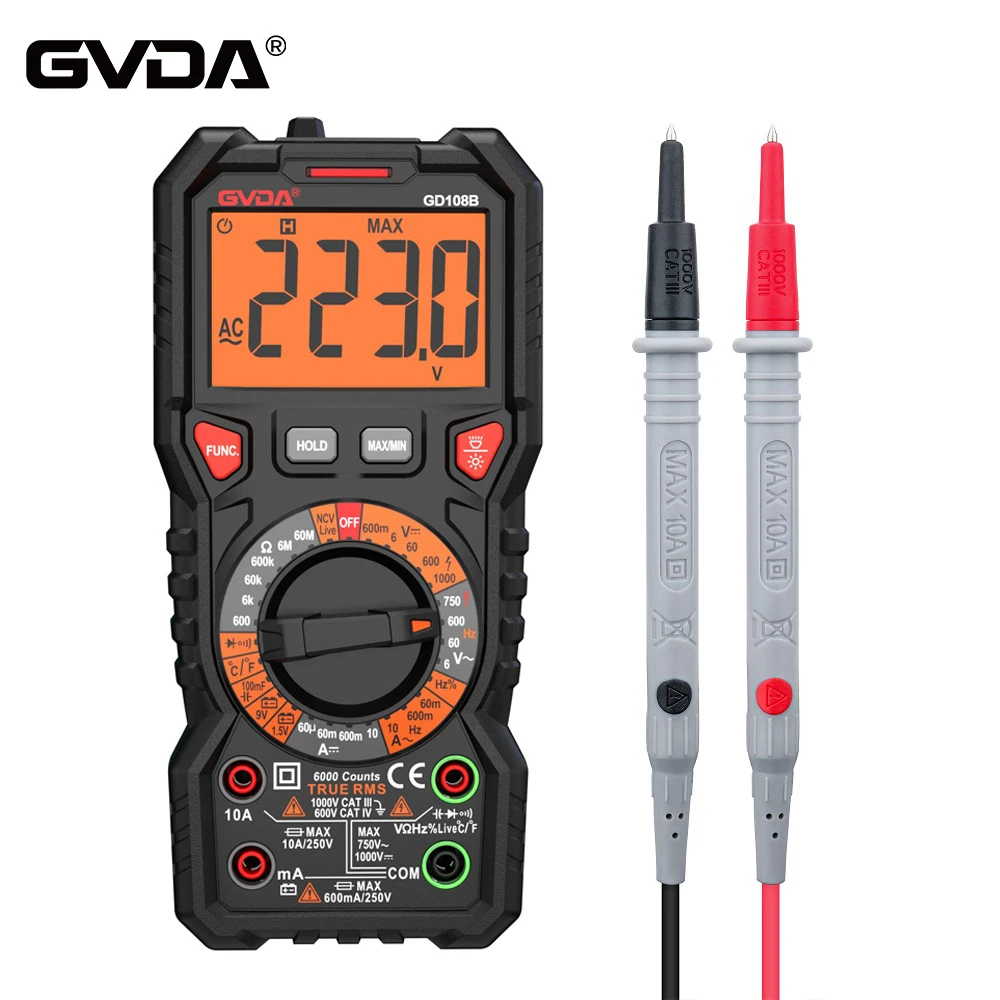
The method of judging forward winding and rewinding with multimeter
For a rotor winding to be repaired, it is impossible to see with the naked eye whether the twisted head of a component is twisted on the left notch or the right notch. It must be judged by measuring the resistance with a multimeter R×1Ω resistance file. The specific operation method is as follows:
Find the last inlaid coil with the naked eye (the sign is that the two ends of this coil are not pressed by other coils). There are two such coils for double winding, and only one such coil (surface element) for overlapping winding.
Use a wallpaper knife to scrape off the insulating layer at the middle of the end of this surface element, and the area to scrape off the insulating skin is slightly larger.
Turn the multimeter to the R×1Ω resistance level, one test lead is in good contact with the scraped insulation layer, and the other test lead is in contact with the commutator piece corresponding to the right slot of the component (the commutator piece corresponding to the center line of the slot is left to right Each 3 pieces), a minimum resistance value will be measured. Then in the commutator segment corresponding to the right slot of the component (the commutator segment corresponding to the center line of the slot is within 3 pieces to the left or to the right), and a minimum resistance value will also be measured. Comparing the two test values, the position where the smallest test lead is placed (near the right or left slot) is the twisted position of the element. If the twist is twisted to the left notch, the forward winding is used; if the twist is twisted to the right notch, the reverse winding is used.
When embedding new components, it must be de-embedded according to the requirements of forward winding or reverse winding.
【Small experience】
After the measurement, it is best to find another component and measure it again according to the above method. The results of the two times are consistent, indicating that the judgment is accurate.
During the test, when the components on the surface have no resistance value twice or the size cannot be compared, another component should be found for measurement. When the components on the surface fail to measure, other components can also be used to measure.
When the end of the component under test scrapes off the insulating layer with a wallpaper knife, it can be scraped anywhere, but the scraped area should not be too small. The place to be scratched should be more enameled wire. When the multimeter pen touches the change point, in order to measure more accurately, it is best to place the test pen horizontally and make contact with the change point as much as possible.