The principle and difference between clamp meter and multimeter to detect current
The main function and working principle of the clamp meter
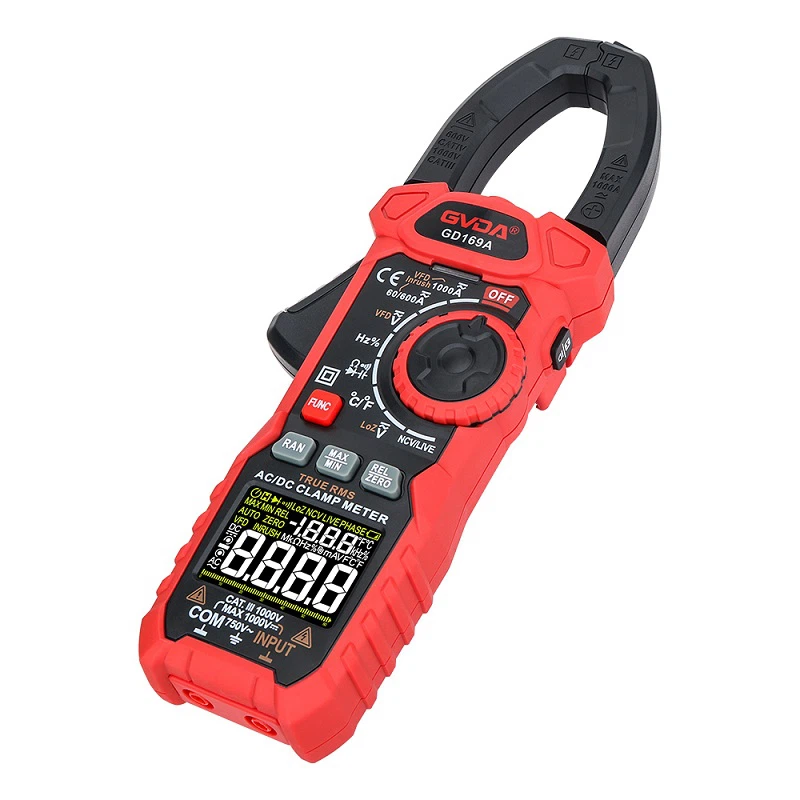
The most prominent feature of the clamp meter is the caliper that can be opened in the front, which can be easily inserted into the wire to measure the current in the loop, so that there is no need to destroy or change the original line, and it can measure a large current. The multimeter also has a current measurement function, so what is the difference between it and the clamp meter to measure current? First of all, let's understand the principle and difference between the detection current of the multimeter and the detection current of the clamp meter.
The principle of multimeter measuring current
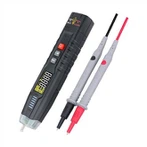
When the multimeter measures the current, it is necessary to disconnect the circuit under test and connect the multimeter in series to measure the current. Through the current detection circuit inside the multimeter, it can be seen that the current gear is actually a resistor with a very small resistance value inside the multimeter. When the current flows through this resistor, a voltage drop will be generated on it, because the resistance value is determined. , as long as the voltage on the resistor is measured, the current through the resistor can be calculated according to the formula, because the resistor is connected in series in the loop, so the current flowing through it is the current of the loop under test.
Therefore, the current measurement circuit in the multimeter, including many current measurement circuits in the instrument, is measured by converting the current into a voltage by means of resistance shunting. The selection of the resistance value of this resistance is also required. If the resistance value is too large, the voltage drop generated when the current passes through the resistance will be large. On the one hand, the larger the resistance value, the greater the power consumption generated on it at the same current, which will make the resistance heat, so considering these two issues, the smaller the resistance value, the better.
However, the resistance value should not be too small. If the resistance is too small, the voltage drop generated when the current flows will be smaller. This will have certain requirements for the subsequent measurement circuit, because the voltage that is too low needs to be amplified before it can be detected by the circuit.
Disadvantages of multimeter measuring current
It can be seen from the method and principle of the multimeter to detect the current that the multimeter needs to be connected in series in the circuit under test when measuring the current, which is inappropriate in some circuits that cannot be powered off and measured. Another point is the measurement range of the multimeter current, usually The maximum measurement range of the multimeter current is generally 10A or 20A, and in order to prevent the internal current-sensing resistor from heating, the multimeter is not allowed to measure large currents for a long time. For the measurement of large currents, it is not easy for ordinary multimeters to achieve.
The principle of clamp meter measuring current
The working principle of the clamp meter for measuring current is basically the same as that of the multi-purpose pen for measuring current. The difference is that the clamp meter does not directly detect the voltage on the shunt resistor, but uses a current transformer. The transformer is actually an application of the transformer, which can transform the current according to a certain ratio. After the current transformer is connected to the load, its primary is equivalent to one turn, and the secondary is the number of turns inside the clamp meter. In this way, the current is reduced according to a certain ratio, so the current transformer is equivalent to A step-up transformer, the circuit inside the clamp meter can calculate the measured current by detecting the voltage on the secondary side of the transformer.
Therefore, compared with the multimeter, the clamp meter does not need to change the circuit when measuring the current, and can measure larger currents, such as the current of inductive loads such as motors. However, because the current transformer is used inside the clamp meter, according to the working principle of the transformer, it cannot pass direct current. So the clamp meter really can't measure DC current? In fact, the clamp meter can measure DC current, but it does not use a current transformer.
Clamp Meter Measuring DC Current Principle
Since DC cannot produce changes in magnetic flux, the clamp meter cannot measure DC current if it uses a current transformer. The transformer is used to measure AC current, which is called electromagnetic transformer, while the clamp meter for measuring DC current uses another sensor-Hall sensor.
The principle of using the Hall sensor to measure DC current is: when the current flows through the wire, a magnetic field (similar to an electromagnet) will be generated, and this magnetic field is proportional to the magnitude of the current. After the caliper of the clamp meter collects the magnetic field generated by the wire, it is detected by the Hall element located in the caliper. The Hall element is a magnetic sensitive element that converts the magnetic field into a voltage signal for output. This voltage signal is amplified by the circuit After processing, the load current can be displayed. Many of the current clamp meters are AC and DC dual-purpose, and the interior also contains electromagnetic transformers and Hall sensors to detect AC current and DC current respectively.
The difference between clamp meter and multimeter
As mentioned above, the main function of the clamp meter is to detect current. Compared with the multimeter, the clamp meter is more convenient to use for detecting current, and the measurement range is much larger than that of the multimeter, but there is one point , The clamp meter cannot display normally when measuring a small current (such as a small current of several hundred milliamperes), and its measurement accuracy is not as good as that of a multimeter.
The second difference is that the main function of the clamp meter is to detect current, so it is not as good as the multimeter in terms of other functions. Although many clamp meters now integrate many functions of multimeters, such as voltage measurement, resistance measurement, frequency measurement, temperature measurement, etc., in general, these functions other than current measurement are not comparable to multimeters. And the accuracy of these measurement gears is generally worse than that of the multimeter.