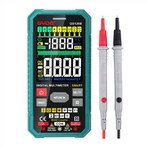
The process and experience of measuring resistance with a multimeter
Regarding the method of measuring resistance with a multimeter, the process of measuring resistance with an analog multimeter, pay attention to selecting the gear for zeroing the resistance, and share the experience of measuring resistance with a multimeter. According to the different resistance error levels, the difference between the reading and the nominal resistance value is allowed to be ±5 %, ±10% or ±20% error.
The process of measuring resistance with a pointer multimeter:
1. First select the gear (there are ×1, ×10, ×100, ×1K, etc.), then put the two test leads in direct contact, and adjust the zero-setting resistor (the potentiometer can be rotated) to make the pointer point at the 0 ohm scale. (This step is called "resistance zero adjustment")
2. Then connect the two test leads to both ends of the resistor to be measured (note that this resistor should not be connected to other circuits), then the resistance value of the resistor is the indication * multiple.
For example: using the ×100 scale and the pointer pointing at the 20 scale, the result is 20*100=2000 euros.
Testing experience:
1) Due to the nonlinear relationship of the electrical barrier scale; the distribution in the middle section is relatively fine, so the pointer indication value should be as close as possible to the middle position of the scale, that is, within the 20%-80% arc range from the beginning of the full scale. Make measurements more accurate.
Depending on the resistance error level, an error of ±5%, ±10% or ±20% is allowed between the reading and the nominal resistance value. If it does not match and exceeds the error range, it means that the resistor has changed value.
2) When testing, especially when measuring a resistor with a resistance of tens of k ohms or more, do not touch the test leads and the conductive parts of the resistor with your hands. The resistor to be tested must be soldered from the circuit, and at least one end must be soldered open to avoid possible damage in the circuit. Other components will affect the test and cause measurement errors. Although the resistance value of the color ring resistor can be determined by the color ring mark, it is best to use a multimeter to measure the actual resistance value when using it.
For the detection of cement resistance, since it is usually a fixed resistance, the method of detecting cement resistance is exactly the same as that of ordinary fixed resistance.