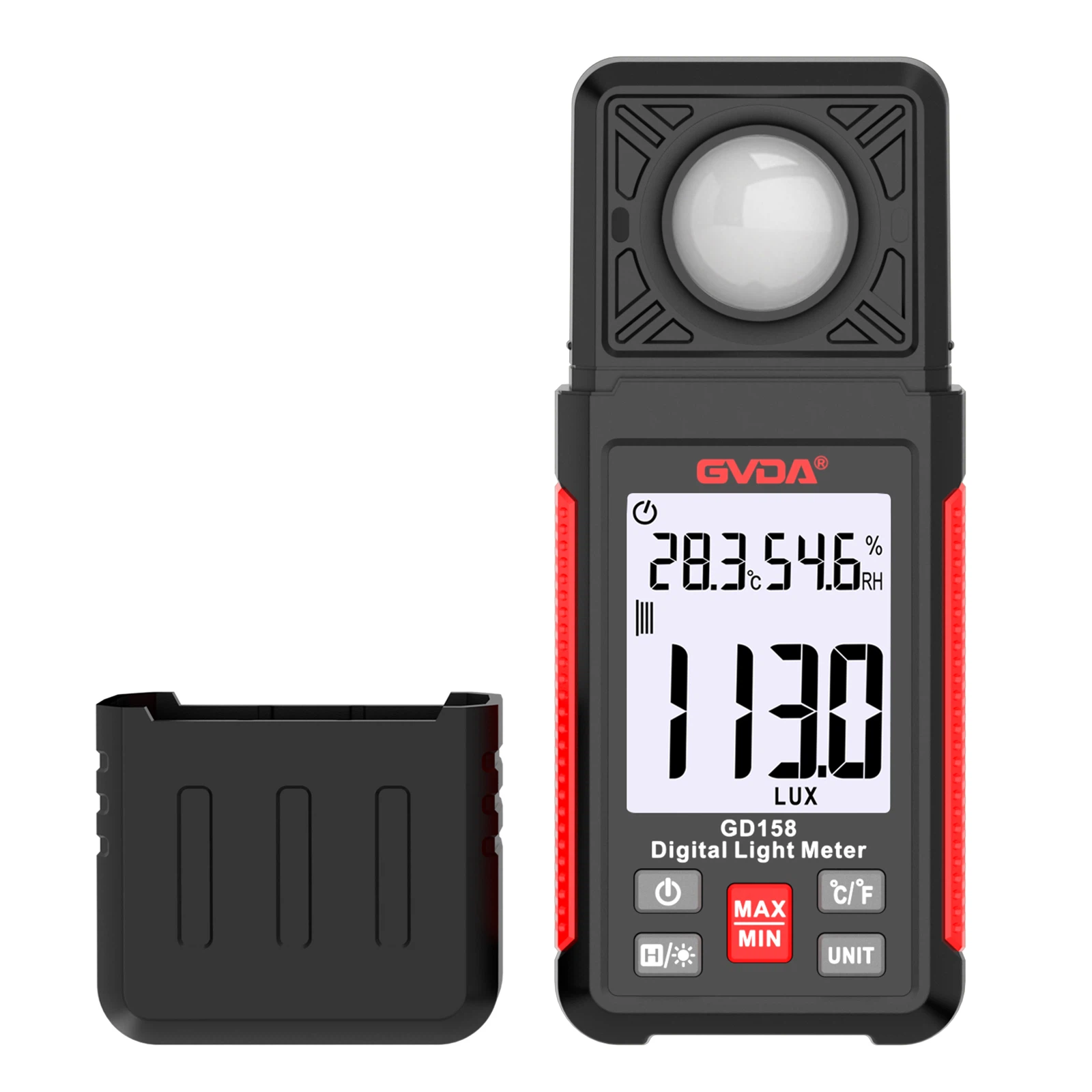
The relationship between illuminance and brightness detected by illuminance meter and luminance meter
The relationship between illuminance and brightness detected by illuminance meter and luminance meter:
In our daily lives, we have always been exposed to light, and when it comes to light, we will definitely talk about illumination and brightness.
So what is the difference between brightness and illuminance?
The concept of illuminance detected by illuminance meter:
In short, the total amount of light emitted by the bulb (luminous flux) enters a certain surface layer with a certain intensity - luminous intensity (luminous intensity), and then the luminosity of this surface layer can be measured.
The concept of brightness measured by a luminance meter:
Brightness refers to the physical quantity of the light (reflection) intensity on the surface of a luminous body (reflector). The human eye observes the light source from one direction. The ratio of the light intensity in this direction to the intensity of the human eye "seeing" the light source area is defined as the brightness of the light source unit, that is, the luminous intensity of the unit's expanded area. When we stand at a certain location and look at a surface, we see the brightness level (brightness) of the surface.
To sum up: illumination is an objective parameter. It is the total amount of light that we use instruments to detect that actually reaches a certain surface; brightness refers to the level of light emitted or reflected by an object perceived by the human eye.
Furthermore, the illumination value is the same whether the surface is black or white, wood or stone. Surfaces will reflect light, either specularly or more likely diffusely. Light is refracted in many directions in space.
What impact do illumination and brightness have on our lives?
It can be said that all indoor space lighting should evaluate the horizontal lighting of the work surface, but we should pay attention to the adaptability of lighting and color temperature. For example, in our work, it is not enough to change the color of the office lights, but we must also pay attention to the lighting.
▲High illumination and low color temperature will make people feel hot, while low illumination and high color temperature will make people feel gloomy and tired, leading to a decrease in work efficiency.
Relevant tests show that at the same time between 300lx and 500lx, as the illumination level increases, workers' satisfaction will significantly increase; at 500lx, workers' satisfaction is basically saturated, and the increase in illumination levels will not significantly change workers' evaluation of the lighting environment. Therefore, China's latest office lighting standard is 300 lx-500 lx, which is also the most suitable illumination for the work surface.
In addition, in the dining space, there must be enough light in the indoor environment and on the dining table to meet the basic dining needs of customers. According to the recommendations of the China Lighting Association in China's architectural lighting design standards, 200 lx is appropriate for dining table lighting.
China's architectural lighting design standards require that the illuminance at a 00.75m plane in a Chinese restaurant shall not be less than 200lx, and that in a Western restaurant shall not be less than 100lx. The illumination value of each space position shall be determined.