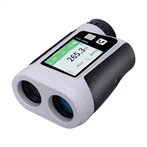
A clamp meter (clamp meter) is an instrument that integrates a current transformer and an ammeter, and is an important branch of a digital multimeter; it is a portable instrument that can directly measure the AC current of a circuit without disconnecting the circuit.
Structure and Principle
The clamp meter is essentially composed of a current transformer, a clamp wrench and a rectifying magnetoelectric system with reaction force meter.
A clamp meter works on the same principle as a transformer. The primary coil is the wire passing through the clamp core, which is equivalent to the primary coil of a 1-turn transformer, which is a step-up transformer. The secondary coil and the ammeter for measurement constitute the secondary circuit. When an alternating current passes through the wire, it is this coil that generates an alternating magnetic field, and an induced current is generated in the secondary loop. The ratio of the current to the primary current is equivalent to the inverse ratio of the turns of the primary and secondary coils. . The clamp-type ammeter is used to measure large current. If the current is not large enough, the primary wire can be passed through the clamp-type meter to increase the number of turns, and at the same time divide the measured current by the number of turns.
The secondary winding of the through-core current transformer of the clamp ammeter is wound on the iron core and connected to the AC ammeter, and its primary winding is the wire under test that passes through the center of the transformer. The knob is actually a range selection switch, and the function of the wrench is to open and close the movable part of the iron core of the through-core transformer, so as to make it clamp the conductor under test.
When measuring the current, press the wrench, open the jaws, and place the measured current-carrying wire in the middle of the through-core current transformer. A current is induced in the side winding, and the current passes through the coil of the electromagnetic ammeter to deflect the pointer and indicate the measured current value on the dial scale.
After putting the tested wire into the window through the iron core button, pay attention to the good fit between the two surfaces of the jaws, and do not let other objects be in the middle;
The minimum range of the clamp meter is 5A, and the display error will be larger when measuring smaller currents. This can be measured after winding the energized wire on the clamp meter for a few weeks, and the reading obtained is divided by the number of turns to obtain the required result.